

Time is money. But unlike money, once time is gone, you cannot earn it back.
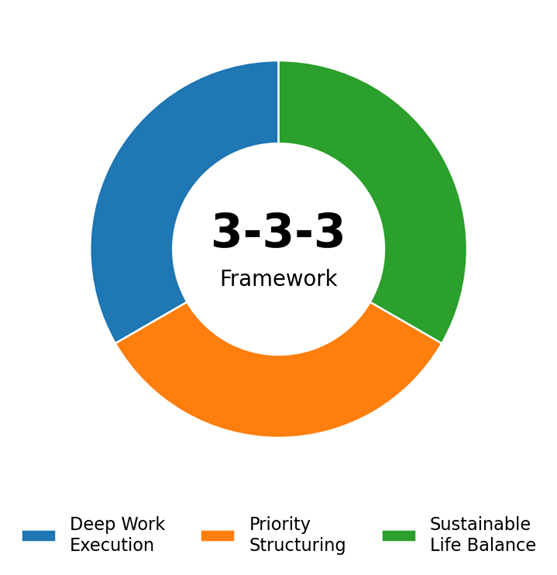
Time management usually fails not because you have too much to do, but because everything feels equally important at the same time. Here, this is Comprehensive Framework for:
- Deep Work Execution
- Priority Structuring
- Sustainable Life Balance
Today, our days are filled with notifications, long to-do lists, and too many things competing for our attention. We may stay busy for hours and still end the day feeling like we did not complete the work that actually mattered.
The 3-3-3 Rule for time management, popularized by author Oliver Burkeman, offers a simpler way to organize your day. Instead of trying to fit everything into your schedule, it helps you focus on a few important tasks, handle smaller responsibilities, and still work within realistic limits. The goal is not to do more and more. It is to use your time better, reduce overwhelm, and make meaningful progress every day.
Table of Contents
1. Understanding the 3-3-3 Rule: The Three Core Pillars Explained
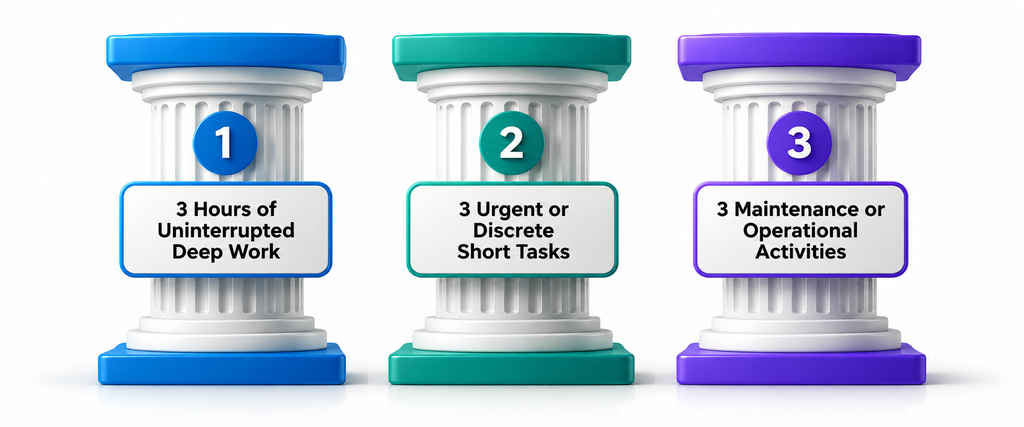
Pillar 1: 3 Hours of Uninterrupted Deep Work
The first and most important pillar requires dedicating three continuous or semi-continuous hours to your primary deep work project. Deep work represents high-cognition tasks that demand intense focus, analytical reasoning, creative synthesis, or complex problem-solving.
Examples include writing a research thesis, drafting strategic business proposals, programming software architecture, or creating detailed educational curricula.
During these three hours, passive distractions must be completely eliminated. Smartphone notifications are silenced, social media apps are blocked, and email clients are closed. Protecting these three hours ensures that regardless of what happens during the remainder of the day, your most important career-building objective moves forward significantly.
Pillar 2: 3 Urgent or Discrete Short Tasks
The second pillar addresses necessary, time-sensitive tasks that require active attention but do not demand profound creative flow. These are discrete deliverables that typically take between 15 to 30 minutes each to complete.
Examples include reviewing an essential document, submitting a client quote, finalizing financial reports, or holding a brief alignment meeting with a colleague.
By capping these tasks at exactly three per day, you prevent secondary demands from expanding infinitely and crowding out your primary creative focus.
Pillar 3: 3 Maintenance or Operational Activities
The third pillar covers operational upkeep and routine life maintenance. These activities are necessary for smooth administrative functioning, digital organization, and personal well-being.
Examples include clearing your email inbox to zero, organizing project files, scheduling upcoming appointments, preparing healthy meals, or completing a workout routine.
Including maintenance tasks as an explicit third pillar prevents administrative build-up, ensuring that operational clutter does not accumulate over time.
2. Why the 3-3-3 Rule Works with Your Brain
Your brain is not designed to stay intensely focused for the entire day.
Even if you sit at your desk for eight hours, your best concentration usually appears in shorter periods. After too much demanding work, your attention starts to drop, decisions feel harder, and even simple tasks can take longer.
That is why the 3-3-3 Rule works well: it does not expect maximum focus from you all day. It helps you use your strongest mental energy where it matters most.
Use Your Best Focus for Important Work
The prefrontal cortex plays an important role in concentration, planning, decision-making, and problem-solving. These are exactly the skills you use during deep work.
Instead of spending your freshest hours on emails, messages, or small administrative tasks, the 3-3-3 Rule encourages you to protect your best focus for meaningful work.
For example, if you need to prepare an important proposal, create a business strategy, or solve a difficult problem, it makes more sense to do that when your mind is fresh rather than after hours of meetings and emails.
Stop Making Your Brain Constantly Switch
Now imagine this:
You are preparing an important presentation. A message arrives, so you check it. Then you open your email. Then someone calls you. A few minutes later, you return to the presentation.
You may be back at the same screen, but your mind is not fully back yet.
This is known as attention residue. When you move from one task to another, part of your attention can remain on the previous task.
The more often you switch, the harder it becomes to concentrate deeply.
The 3-3-3 Rule reduces this problem by grouping your work into clear blocks. Instead of constantly moving between major work, emails, calls, and routine tasks, you give each type of work its own time.
| Simple tip: During your deep-work block, keep a small note beside you. If you remember something like “reply to that email” or “call the client,” write it down instead of doing it immediately. Finish your focus block first, then deal with it later. |
The result is simple: less switching, fewer distractions, and more useful work from the same amount of time.
3. Step-by-Step Practical Blueprint for Daily Implementation
Implementing the 3 3 3 Rule effectively requires an intentional daily schedule. Here is a step-by-step workflow to structure your day for peak results:
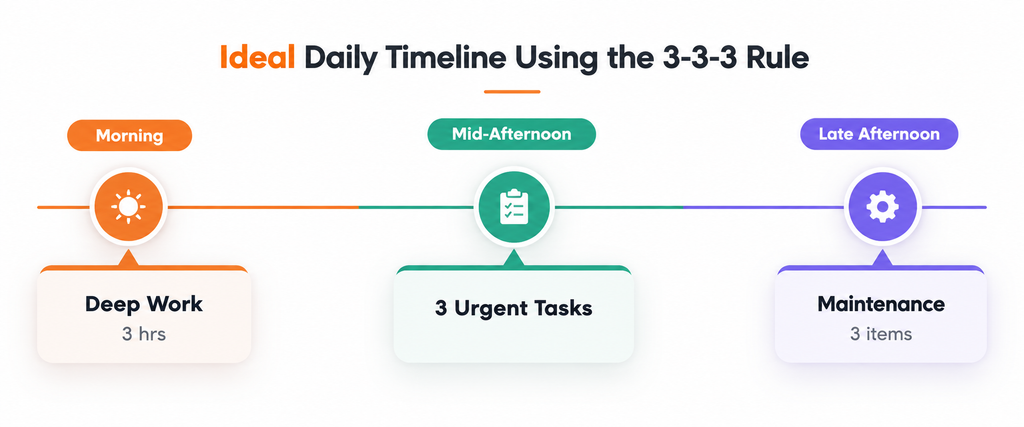
Step 1: Define Your Deep Work Target the Night Before. Before finishing work for the evening, identify the single major project for tomorrow’s 3-hour deep work block. Deciding in advance eliminates morning hesitation and decision fatigue.
Step 2: Reserve Your Peak Energy Window for Deep Work. Schedule your 3 hours of deep work during your period of highest alertness usually first thing in the morning. Put your phone in another room and disable messaging apps.
Step 3: Execute Your 3 Urgent Tasks in the Mid-Afternoon. After completing your deep work block and taking a restorative lunch break, tackle your three discrete urgent tasks while your energy is stable.
Step 4: Close Your Workday with Maintenance Activities. Spend the final portion of your afternoon processing administrative items, clearing your inbox, and setting up tomorrow’s space. This creates a clear boundary between work and personal life.
4. 3-3-3 Rule vs. Other Productivity Methods
There is no single productivity method that works perfectly for everyone. The best system depends on your problem.
If you struggle with too many priorities, the 3-3-3 Rule can help simplify your day. If you struggle with starting tasks, Pomodoro may help. If your problem is planning your schedule, time blocking may be more useful.
Here is a simple comparison:
| Productivity Method | How It Works | Best For | Possible Limitation |
| 3-3-3 Rule | 3 hours of focused work + 3 important short tasks + 3 maintenance tasks | People who want a simple daily structure without an overloaded to-do list | May need adjustment on days filled with meetings or unexpected work |
| Pomodoro Technique | Work for around 25 minutes, then take a short break | People who struggle to start, stay focused, or avoid procrastination | Short work intervals may interrupt tasks that require long, uninterrupted thinking |
| Time Blocking | Assign specific time slots to different tasks in your calendar | People who want more control over when work gets done | A tightly planned day can become difficult to follow when unexpected tasks appear |
| Eisenhower Matrix | Sort tasks by urgency and importance | People who struggle to decide what deserves attention first | Helps with prioritizing, but does not tell you exactly how to structure your working time |
The important point is that you do not have to choose only one method.
You can combine them.
For example, you can use the Eisenhower Matrix to decide which task is most important, use the 3-3-3 Rule to structure your day, and use Pomodoro-style breaks inside your deep-work block.
The best productivity system is the one that makes your day easier to manage, not more complicated.
5. Common Challenges and Simple Solutions
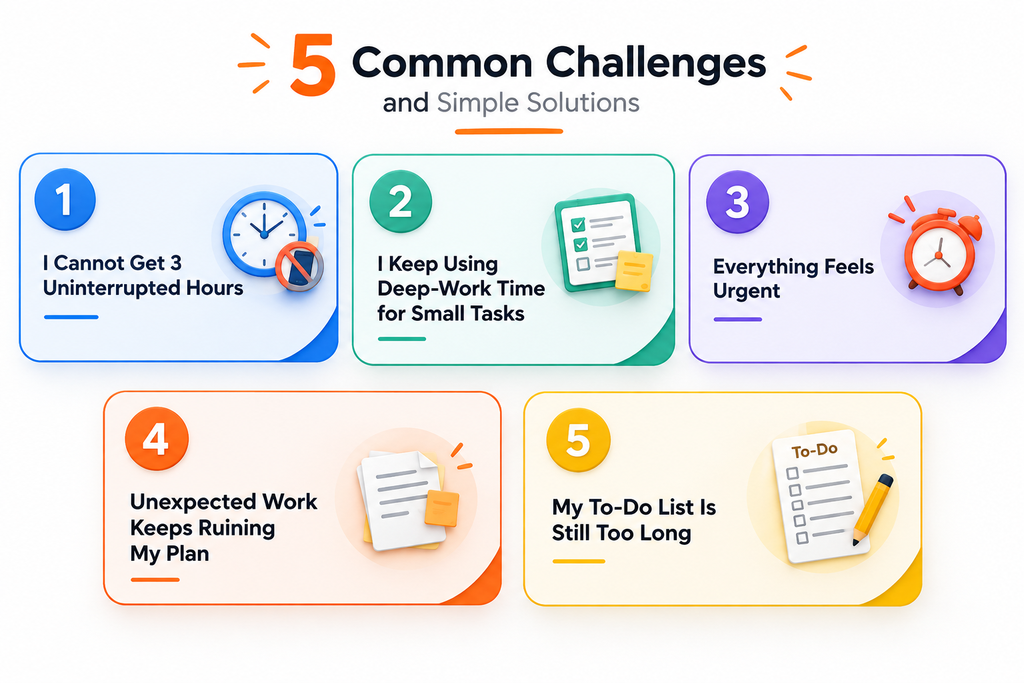
Even a simple system will not work perfectly every day. Meetings appear, urgent work comes up, and plans change.
Instead of abandoning the 3-3-3 Rule, adjust it to your real schedule.
Challenge 1: “I Cannot Get 3 Uninterrupted Hours”
If your day is full of meetings, calls, or team discussions, three continuous hours may not be realistic.
Try this instead:
- 90 minutes in the morning + 90 minutes later
- three 60-minute focus blocks
- one strong 90-minute block on especially busy days
The important thing is to protect focused time, even if it is divided.
Challenge 2: “I Keep Using Deep-Work Time for Small Tasks”
It is easy to spend your best hours replying to emails, checking reports, or finishing routine admin work because these tasks feel productive.
But deep-work time should be reserved for work that needs serious concentration.
Ask yourself:
Does this task require real thinking, planning, creating, or problem-solving?
If the answer is no, it probably belongs in your short-task or maintenance section.
Challenge 3: “Everything Feels Urgent”
When everything feels urgent, your priority list becomes useless.
Before adding a task, ask:
- Does this really need to be done today?
- What happens if I do it tomorrow?
- Is this important, or is it simply demanding my attention?
This helps separate real priorities from unnecessary pressure.
Challenge 4: “Unexpected Work Keeps Ruining My Plan”
Do not fill every minute of your day.
Leave some space for unexpected calls, delays, or urgent requests.
Even a small buffer between work blocks can stop one surprise task from disturbing your entire schedule.
Challenge 5: “My To-Do List Is Still Too Long”
Keep a separate Not Today List.
Move tasks there if they matter but do not need your attention right now.
This helps you stay focused without worrying that you will forget them.
The goal of the 3-3-3 Rule is not to complete everything.
It is to make sure the right things get your time first.
Conclusion: Make Your Time Work for You
Time management is not about filling every hour of your day with work.
It is about knowing what deserves your attention, what can wait, and what actually moves your life or work forward.
The 3-3-3 Rule makes that easier by giving your day a simple structure:
- focused time for your most important work
- a few smaller priorities that need attention
- routine tasks that keep everything running smoothly
You do not have to follow the rule perfectly every single day.
Some days you may have three hours for focused work. On other days, you may only have one.
Some days your priorities will change.
That is completely fine.
The real value of the 3-3-3 Rule is that it helps you stop treating every task as equally important.
Instead of asking:
“How can I fit everything into today?”
start asking:
“What are the few things that deserve my time today?”
That one change can make your schedule feel much more manageable.
Try It Tomorrow
Before ending your day, write down:
1 important task that deserves your best focus
3 smaller tasks that genuinely need attention
3 simple maintenance tasks
Then leave the rest for later.
Because good time management is not about doing everything.
It is about making sure the right things get done first.
| Try the 3-3-3 Rule Yourself: Free Daily Planning Template.” |
3-3-3 DAILY TIME MANAGEMENT PLANNER
| DATE: ____________________________ |
| ONE RESULT THAT WOULD MAKE TODAY FEEL PRODUCTIVE: ________________________________________________ |
| 1. MY DEEP WORK Main task / project: ________________________________________________________________ Why does this matter today? _________________________________________________________ My focus time: __________ to __________ Protect this time: ☐ Phone away ☐ Notifications off ☐ Unnecessary tabs closed ☐ Meetings avoided If 3 continuous hours are not possible: ☐ 90 + 90 min ☐ 60 + 60 + 60 min ☐ My own schedule: __________ |
| 2. MY 3 IMPORTANT SHORT TASKS Choose only three tasks that genuinely need attention today. 1. _________________________________________________________________ ☐ Done 2. _________________________________________________________________ ☐ Done 3. _________________________________________________________________ ☐ Done Quick check: Can any of these wait until tomorrow? __________________________________ |
| 3. MY 3 MAINTENANCE TASKS Choose three small actions that will keep your work or personal life organized. 1. _________________________________________________________________ ☐ Done 2. _________________________________________________________________ ☐ Done 3. _________________________________________________________________ ☐ Done Examples: update calendar, organize files, clear important emails, exercise, prepare for tomorrow. |
| NOT TODAY LIST Write down tasks that matter but do not need your attention today. 1. ________________________________________________________________________________ 2. ________________________________________________________________________________ 3. ________________________________________________________________________________ |
| END-OF-DAY 2-MINUTE CHECK Did I make progress on my most important task? ☐ Yes ☐ Partly ☐ No What distracted me most? __________________________________________________________ What should I do differently tomorrow? _____________________________________________ Tomorrow’s most important task: ____________________________________________________ |
REMEMBER: You don’t need to finish everything today. You need to make sure the right things get your time first.
Levikah Daila
| Date: ______________________ | Before You Start | What is the ONE result that would make today feel productive? ________________________________________ |
| 1. My Deep Work Main task/project: ________________________________ Why does this matter today? ________________________________ My focus time: ________ to ________ How will I protect this time? ☐ Phone on silent / away ☐ Notifications off ☐ Unnecessary tabs closed ☐ Meetings avoided during this block ☐ Other: ____________________ If 3 continuous hours are not possible, I will divide them into: ☐ 90 + 90 minutes ☐ 60 + 60 + 60 minutes ☐ My own schedule: ____________________ | 2. My 3 Important Short Tasks Choose only three tasks that genuinely need attention today. 1. __________________________ ☐ Done 2. __________________________ ☐ Done 3. __________________________ ☐ Done Quick check: Can any of these wait until tomorrow? ____________________ | 3. My 3 Maintenance Tasks Choose three small actions that will keep your work or personal life organized. 1. __________________________ ☐ Done 2. __________________________ ☐ Done 3. __________________________ ☐ Done Examples: update your calendar, organize files, clear important` emails, exercise, prepare for tomorrow, or review your schedule. ________________________________ |
| Not Today List Write down tasks that matter but do not need your attention today. ________________________________________ ________________________________________ ________________________________________ This keeps them out of your head without allowing them to take over today’s priorities. ________________________________________ | End-of-Day 2-Minute Check Did I make progress on my most important task? ☐ Yes ☐ Partly ☐ No What distracted me most today? ________________________________ What should I do differently tomorrow? __________________________ Tomorrow’s most important task: ________________________________ | |
| Remember You don’t need to finish everything today. You need to make sure the right things get your time first. | Levika Daila | |
❓ Frequently Asked Questions (FAQs)
Q1: Who created or popularized the 3-3-3 Rule for Time Management?
A: The 3-3-3 Rule was popularized by Oliver Burkeman, a renowned author and productivity expert known for his book Four Thousand Weeks: Time Management for Mortals. The system was designed to help people move away from overwhelming to-do lists and focus on intentional, high-impact work.
Q2: What if I cannot get 3 continuous hours for Deep Work due to meetings?
A: You do not need to do all 3 hours in a single continuous block. If your schedule is filled with meetings or calls, you can break the deep work period into smaller, manageable chunks—such as two 90-minute blocks, three 60-minute sessions, or even a single focused 90-minute block on extremely busy days.
Q3: How is the 3-3-3 Rule different from the Eisenhower Matrix or Pomodoro Technique?
A: Each framework serves a different purpose:
- Eisenhower Matrix: Helps you prioritize tasks by urgency and importance, but doesn’t structure your working hours.
- Pomodoro Technique: Focuses on short, timed work intervals (e.g., 25 minutes) to build momentum and avoid procrastination.
- 3-3-3 Rule: Provides a balanced daily structure by combining deep focus execution (3 hours), short urgent priorities (3 tasks), and daily upkeep (3 maintenance activities).
Tip: You can use all three together by using the Eisenhower Matrix to choose your tasks, the 3-3-3 Rule to structure your day, and Pomodoro intervals during your deep work block!
Q4: What should I do if unexpected tasks ruin my planned schedule?
A: Avoid scheduling every single minute of your day. Leave buffer spaces between your work blocks for unexpected calls, urgent requests, or delays. Additionally, maintain a “Not Today List” to dump non-urgent thoughts and tasks so they don’t derail your current priorities.
Q5: Can I customize the 3-3-3 Rule for part-time work or study schedules?
A: Yes, absolutely! The core idea is to respect cognitive limits and prioritize effectively. If you are a student or working part-time, you can scale the numbers down (e.g., 1.5 hours of deep study, 2 urgent short tasks, and 2 maintenance activities).
[…] Read the 3-3-3 Rule for Time Management […]