

Become a dangerously good communicator through clearer everyday conversations.
Become a dangerously good communicator through clearer everyday conversations.
By Levikah Daila • Communication and Confidence
Effective communication skills help you turn the thoughts in your head into something other people can understand. You can know the answer in class, have a great idea for a group project, or care deeply about something and still struggle to explain it. That gap can feel frustrating, especially when someone else says what you meant and suddenly everyone listens.
Being heard does not always depend on having more to say. Sometimes it depends on choosing a clearer sentence, listening properly, or giving your words a moment to land. These seven habits can help you do that in classrooms, presentations, friendships, and everyday conversations.
THE BIG IDEA | Stop trying to sound smart. Start trying to be understood.
What are effective communication skills
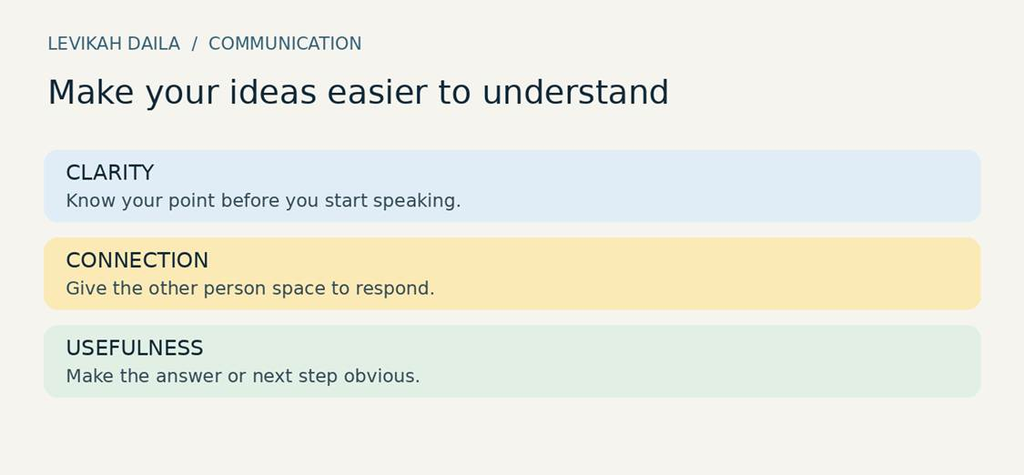
Effective communication skills are the habits that help you share a message clearly and understand the person responding. They include speaking, listening, asking useful questions, choosing an appropriate tone, and checking whether your meaning came across. Perfect English and a loud voice are not requirements.
Table of Contents
- What are effective communication skills
- 1 Why people get ignored even when they are right
- 2 Why nervous people over explain
- 3 Why confidence needs substance
- 4 Make people feel clear rather than small
- 5 Effective communication skills start with one clear point
- 6 Listen and adjust to the person
- 7 Get comfortable with pauses
- Common habits and clearer alternatives
- A simple daily practice challenge
- Frequently asked questions
- What are the most important effective communication skills
- How can students improve communication skills
- How can I speak confidently when I feel nervous
- How do I stop over explaining
- Do I need perfect English to communicate well
- What is the difference between communication and public speaking
- Can AI help me practise communication skills
- Make your next conversation clearer
1 Why people get ignored even when they are right
Here is something frustrating. Being right does not guarantee that people will listen to you. You can have the facts.
You can have the logic.
You can even have the solution. And still lose the conversation. Why? Because people do not respond only to information. They respond to how that information reaches them. Imagine two people disagreeing. The first person says:
“No, you’re wrong. That doesn’t make any sense. This is obviously the better way.” Maybe they are completely right. But instantly, the other person becomes defensive. Now imagine someone saying: “I understand why you’re looking at it that way. But there’s one part we might be missing.” Same disagreement. Completely different reaction. A dangerously good communicator understands something most people miss:
Winning the point is not the same as winning the person. If your communication makes someone feel attacked, embarrassed, or stupid, they may stop listening even when your argument is correct. And this happens everywhere. In classrooms.
At work.
With friends.
With parents.
In meetings.
Even in comments online. Sometimes people are not rejecting your idea. They are reacting to the way you delivered it.
So before trying to prove that you are right, ask yourself: How can I make this easier for the other person to understand? That one change makes you a much stronger communicator. Because great communicators do not throw information at people. They make information easier to receive.
TRY THIS TODAY | Before disagreeing with a classmate, explain what you understood about their idea. Then add the part you see differently. Respectful delivery helps a discussion, but it does not guarantee agreement.
2 Why nervous people over explain
Have you ever answered a simple question and halfway through your answer thought: “Why am I still talking?” You already made your point. But then you explain it again. And again. You add another example. Then another sentence. Then you start correcting the sentence you said ten seconds ago. This happens because nervousness makes silence feel dangerous.
When we are unsure of ourselves, we often think: Maybe they did not understand me. Maybe that sounded stupid. Maybe I should explain more. Maybe I need to prove that I know what I am talking about. So we keep talking. But here is the problem. The more unnecessary words you add, the weaker your strongest words become. Imagine someone asks you:
“Why do you think this idea will work?” One answer is: “I think it will work because students already have this problem, there is clear demand for a solution, and we have a simple way to test it.” Clear. Done. But someone who is nervous might say:
“Well, I think it could work because obviously there are students who need it, and I’ve noticed this quite a lot, and obviously I’m not saying that everyone needs it, but I do think there’s definitely some demand, and I was also thinking that maybe…” The idea did not become smarter. It became harder to follow. Confidence often sounds like knowing when to stop.
You do not need ten sentences when three will do the job. You do not need to defend every word before somebody has even challenged you. And you definitely do not need to fill every second of silence. Say what matters. Let it land. Pause. A pause does not make you look confused. Sometimes it makes you look like you actually meant what you said.
TRY THIS TODAY | Use one point, one reason, and one example. Add details when someone asks or when the situation needs them. Not everyone who explains at length is nervous; sometimes a topic simply needs more context.
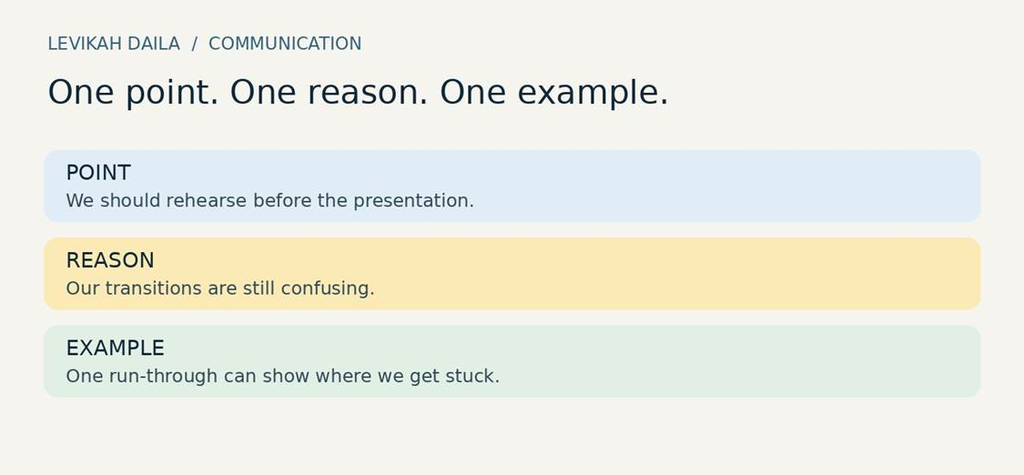
A clear-answer formula for practising effective communication skills.
3 Why confidence needs substance
Now there is another side to this. Some people sound incredibly confident. Strong voice.
Perfect posture.
No hesitation. But when you actually think about what they said… There was almost nothing there. This is one of the biggest mistakes people make when learning communication. They confuse confidence with substance. You can speak beautifully and still say absolutely nothing useful. A powerful communicator does not ask:
“How do I sound impressive?” They ask: “What does the other person need from me right now?” Maybe they need an answer. Maybe they need an example. Maybe they need reassurance. Maybe they need a decision. Maybe they simply need you to listen. That changes everything. Because now communication stops being a performance. It becomes useful.
If someone asks you a question, answer the question before giving them your entire life story. If someone is confused, simplify. If someone is upset, do not immediately turn the conversation into a lecture. If someone needs instructions, make the next step obvious. The goal is not to make people think: “Wow, this person knows a lot of words.”
The goal is to make them think: “That made sense.” And that brings us to one of the most powerful communication skills of all.
TRY THIS TODAY | Replace “We need to improve our teamwork” with “Let’s decide who makes each slide and finish a first draft by Friday.” Give people something they can actually do.
4 Make people feel clear rather than small
Have you ever spoken to someone who somehow makes you feel stupid for asking a normal question? They sigh. They use unnecessarily complicated language. They interrupt you. They answer as if you should already know everything. Technically, they might be communicating. But they are not communicating well. Because a great communicator does not prove how smart they are by making everyone else feel less intelligent.
They make complicated things feel simple. They make uncomfortable conversations feel safer. They make people feel comfortable saying: “I don’t understand.” And this matters more than most people realise. Imagine someone asks you something you know very well. You could answer with complicated terms and show them how much you know. Or you could explain it so clearly that they finally understand it.
Which one shows greater communication skill? The second one. Clarity is not dumbing something down. Clarity is proof that you understand something well enough to make it understandable to somebody else. And the same rule works emotionally. When someone disagrees with you, you do not have to make them feel stupid.
When someone makes a mistake, you do not have to embarrass them to correct them. When someone is nervous, you do not have to dominate the conversation. Great communicators make other people feel comfortable enough to communicate too. And that is a huge difference. Because communication is not about showing people how powerful you are. It is about making the conversation itself more powerful.
TRY THIS TODAY | When a friend asks for help, begin with what they already understand. Explain the next step, then invite a question without making it feel like a test.
5 Effective communication skills start with one clear point
This might be the simplest rule in this guide. Before you speak, know what you are trying to say. It sounds obvious. But watch how people actually communicate. They start talking before they know their point. They add five unnecessary details. They jump between ideas. Then they finish and wonder why nobody understood them. So build a habit.
Before an important conversation, presentation, phone call, or answer, ask yourself: What is the one thing I need this person to understand? One thing. Not twelve. Once you know that, your communication becomes much cleaner. Your examples become more relevant. Your sentences become shorter. Your message becomes easier to remember. And this is especially important when emotions are high.
Because when we are angry, nervous, excited, or frustrated, our brain wants to say everything. Do not say everything. Say what matters.
TRY THIS TODAY | Before answering in class, finish this sentence in your head: “My main point is…” That small habit gives your explanation a direction.
6 Listen and adjust to the person
Communication is not something you do at another person. It is something happening between two people. So watch what is happening. Are they confused? Are they interested? Are they uncomfortable? Are they trying to speak? Did their expression change? Did you lose them three sentences ago? A weak communicator follows their script no matter what happens. A strong communicator adjusts.
If someone looks confused, they simplify. If someone already understands, they move forward. If someone wants to contribute, they give them space. If the conversation becomes tense, they lower the temperature instead of raising it. You should not enter every conversation thinking: “How do I make myself look confident?” Enter thinking: “How do I make this conversation work?”
That mindset alone can change the way people experience talking to you.
TRY THIS TODAY | Ask “Which part should I explain differently?” rather than assuming a facial expression tells you what someone is thinking. Body language is a clue, not proof.
7 Get comfortable with pauses
Here is a small skill that instantly changes the way you communicate. Stop being afraid of pauses. You ask someone a question. They take three seconds to answer. Do not rescue them. You make an important point. Pause. You are asked something difficult. Take a second. Think. Then answer. You do not need to respond instantly to look intelligent.
You do not need to fill every empty second to look confident. Sometimes the most controlled person in a conversation is simply the person who does not panic when nobody is speaking. Silence gives your words space. Use it.
TRY THIS TODAY | Pause briefly before a difficult answer. If you need longer, say “Let me think for a moment.” Let the other person finish too.
Common habits and clearer alternatives
| Instead of | Try |
| Repeating the same point | Give your point, a reason, and a useful example. |
| Trying to sound impressive | Answer the question the listener actually asked. |
| Assuming you know what they feel | Ask what needs clarification. |
| Filling every silence | Pause and give the other person time. |
A simple daily practice challenge
Choose one ordinary conversation today. Before it starts, decide what you want to explain. During it, let the other person finish, share your main point, and avoid repeating it unless more explanation is needed. Afterwards, note one sentence that worked and one you would simplify next time.
For a five-minute solo practice, record a short explanation of something you learned at school. Listen once. Check whether your main point came early, your example helped, and your ending was clear. Record it again with one improvement. The recording is feedback, not a reason to criticise your voice.
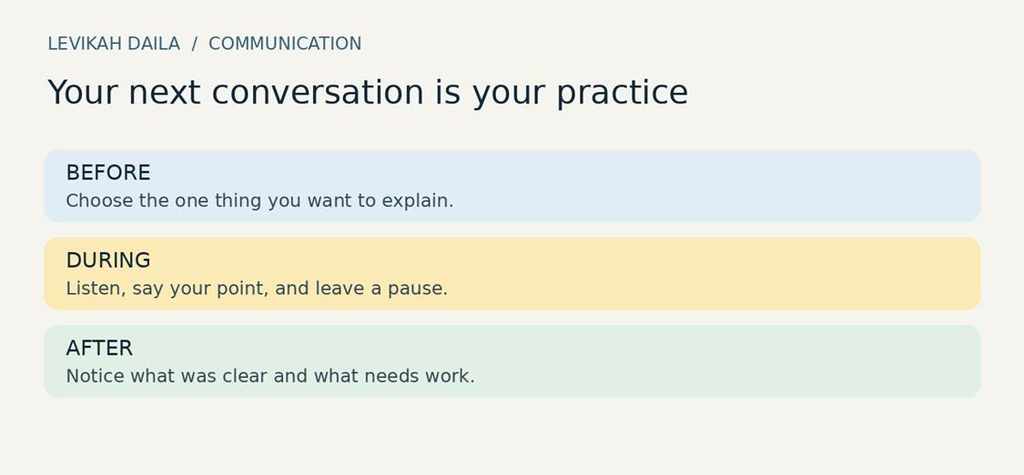
A practical routine for building effective communication skills through everyday conversations.
If making time for practice is the difficult part, use a small daily task in your planning routine:
Read the 3-3-3 Rule for Time Management
Frequently asked questions
What are the most important effective communication skills
Start with clear expression, active listening, respectful delivery, relevant examples, and useful questions. These habits help you share your point and understand the other person, rather than simply taking turns talking.
How can students improve communication skills
Practise explaining a lesson in simple words, contribute one point in a group discussion, and ask a follow-up question when someone speaks. Short, regular practice gives you chances to notice what works.
How can I speak confidently when I feel nervous
Prepare your first sentence and main point beforehand. Pause before answering and give yourself permission to speak slowly. You can explain an idea clearly even while feeling nervous; confidence does not have to come first.
How do I stop over explaining
Give your main answer first, followed by the reason or example that is needed. Then pause. If the listener asks for more detail, add it. The aim is enough information to be understood, not the shortest possible answer.
Do I need perfect English to communicate well
No. Use words you understand and a language your listener is comfortable with. Clear meaning and attentive listening matter. If you want to improve English, practise it alongside communication rather than waiting until it feels perfect.
What is the difference between communication and public speaking
Public speaking usually means addressing a group. Communication also includes one-to-one conversations, listening, messages, feedback, and questions. The skills overlap, but a conversation requires space for the other person to respond.
Can AI help me practise communication skills
Yes. Ask an AI tool to role-play a class discussion or ask questions about a short explanation you wrote. Request feedback on clarity and unnecessary repetition. Check its suggestions yourself and keep practising with real people.
Make your next conversation clearer
You do not need a completely different personality to become a better communicator. Start with one clearer answer, one honest question, or one pause that gives someone else room to speak. Effective communication skills grow through these ordinary moments.
Try one habit from this guide today. In the comments, share which one you chose and what changed. If it helped, send it to a friend who is working on speaking with more confidence.
“Your best sentence is the one that helps someone understand.” — Levikah Daila