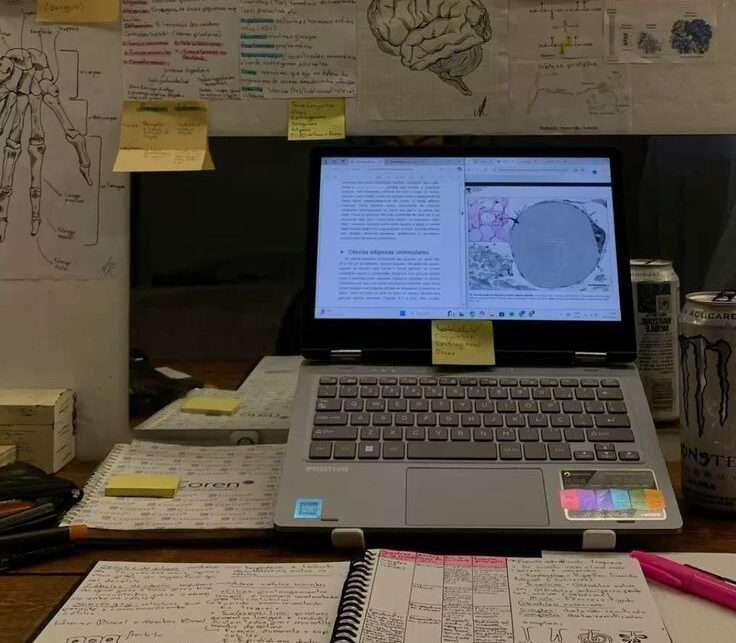

How to Outlearn Everyone is not about studying for more hours, collecting more notes, or trying to become the person who knows everything. It is about learning in a way that makes your brain notice patterns, question confusion, practise what matters, and improve faster each time you return to a skill.
9, 8, 6, 4, 5.
I looked at those numbers only once, but I can still hold them in my mind for a moment. Some people seem unusually good at remembering numbers. Others remember names, formulas, conversations, facts, or tiny details everyone else forgets. When we meet people like that, it is easy to assume they were simply born with a better brain.
But what if that is only part of the story? What if they have trained themselves to process information differently? Once you understand how strong learners actually work, learning stops looking like a mysterious talent and starts looking like a skill you can train.
Today, learning can feel like a race. Everyone wants to understand faster, improve faster, and stay ahead. Knowledge can create confidence, opportunities, independence, and new possibilities. But learning more is not automatically the same as learning better.
You can spend five hours studying and remember almost nothing. Someone else can spend two focused hours, understand the structure of the topic, locate the exact point where they are weak, and retain much more. The difference is not always intelligence. Very often, it is the method.
| THE BIG IDEA: If you want to outlearn everyone, do not ask only, “How much did I study?” Ask, “How well did I understand, test, connect, and use what I learned?” |
Table of Contents
- 1. Before You Learn More, Decide What You Will Stop Doing
- 2. Learn How You Learn: The Power of Metacognition
- 3. Use Confusion as a Compass
- 4. Escape the Accumulation Trap
- 5. Build Something Real and Reverse Engineer Great Work
- 6. Deconstruct the Skill and Attack the Bottleneck
- The 7-Day Outlearn Experiment
- How AI Can Help You Learn Without Doing the Learning for You
- Frequently Asked Questions
- What does “outlearn everyone” actually mean?
- How can I learn faster without studying for longer hours?
- What is metacognition in simple words?
- Is confusion bad when I am learning?
- How do I avoid collecting too many courses and notes?
- What is the best way to practise a new skill?
- Can AI help me outlearn everyone?
- How long does it take to become a faster learner?
- The Skill That Makes Every Other Skill Easier
1. Before You Learn More, Decide What You Will Stop Doing
One of the biggest mistakes in learning is assuming improvement always requires adding something. Another course. Another app. Another study method. Another productivity system. Sometimes the fastest improvement comes from removing what is already slowing you down.
Before creating a learning to-do list, create a not-to-do list. It forces you to notice the habits that consume attention without giving much back.
Three things belong on that list immediately. First, stop waiting for perfect circumstances. You will not always have the perfect desk, perfect mood, perfect teacher, perfect schedule, or perfect amount of time. If your learning system only works in ideal conditions, it is fragile.
Second, stop believing the naturally gifted story too quickly. Yes, people have different strengths. But speed often comes from familiarity, practice, pattern recognition, and better strategies. What looks effortless from the outside may be the result of years of invisible repetition.
Third, stop expecting the environment to stay the same. Tools change. Exams change. industries change. Technology changes. Strong learners do not depend on one fixed method. They adjust.
| DO THIS TODAY: Write three habits that make you feel busy but do not make you better. Remove one of them for the next seven days. |
2. Learn How You Learn: The Power of Metacognition
Two people can read the same book, attend the same class, spend the same amount of time studying, and still improve at completely different speeds. One reason is metacognition.
Metacognition simply means thinking about your own thinking. It is the ability to step back and notice what is happening inside your learning process instead of judging yourself only by the final result.
Imagine an invisible mirror inside your mind. It helps you notice: Where did I lose the idea? What made this easier to remember? Which type of question exposed a weakness? Was I actually learning, or was I only rereading familiar words?
Fast learners do not just move forward. They pause, observe, adjust, and continue. That small cycle creates compounding improvement because every study session teaches them two things: the topic itself and how to learn the topic better next time.
This is one of the most useful answers to how to outlearn everyone. You do not need to know everything today. You need to become better at noticing what helps your own brain understand, recall, and apply information.
| BRAIN CHECK: After studying, ask: What did I understand? What did I only recognize? What can I explain without looking? What should I change next time? |
3. Use Confusion as a Compass
Confusion often feels like evidence that you are bad at something. In reality, it can be evidence that your brain has finally reached the edge of what it understands.
Imagine walking into a room where hundreds of puzzle pieces have been dumped onto a table. At first, everything looks random. Then you find a corner. You notice a repeated colour. You connect two pieces. Slowly, structure appears.
Learning works in a similar way. New information enters your brain and your mind starts asking: Where does this fit? What does this connect to? What am I missing?
Many people escape that moment too quickly. They switch topics, search for a complete answer, copy a solution, or tell themselves, “I am just bad at this.” Strong learners stay with the confusion for a little longer.
Instead of saying, “I do not understand this chapter,” make the problem smaller. Ask, “Which exact line, step, definition, connection, or assumption do I not understand?” Then convert that confusion into a specific question.
Random searching creates noise. Specific questions create direction.
| THE CONFUSION COMPASS: Notice the confusion → locate the exact gap → turn the gap into a question → find or test the answer → explain it in your own words. |
4. Escape the Accumulation Trap
There is a modern learning habit that feels productive even when it is doing very little: collecting.
We save videos, download PDFs, bookmark articles, buy courses, make giant notes, and open endless tabs. The collection grows, so it feels like progress. But stored information is not the same as usable knowledge.
The real power comes from connection. A chess beginner sees individual pieces. An experienced player sees patterns, threats, familiar structures, and possible sequences. The board contains the same pieces, but the expert brain has built more connections.
The same thing happens when you learn science, writing, coding, business, public speaking, history, design, or almost anything else. Facts become useful when they connect to a larger mental model.
So instead of asking, “How much content did I consume?” ask, “What can I connect this to?” Try linking a new idea to something you already know, an example from real life, a previous chapter, a mistake you made, or a problem you are trying to solve.
If you want to learn faster, fewer connected ideas can be more powerful than hundreds of disconnected notes.
Passive Learning vs Outlearning
| Passive Learning | Outlearning |
| Saves more resources | Uses a small number of resources deeply |
| Rereads familiar notes | Tests recall without looking |
| Avoids difficult parts | Locates the exact weak point |
| Measures time spent | Measures understanding and application |
| Copies finished solutions | Studies the process behind the result |
5. Build Something Real and Reverse Engineer Great Work
You can watch twenty editing tutorials and still freeze when you open an editing app. You can read five books about public speaking and still struggle when you stand in front of a room. You can understand a maths example while the teacher solves it and then get stuck when the numbers change.
That happens because recognition is not the same as performance.
Learning becomes stronger when you have to create, build, present, solve, teach, write, design, or make a decision with what you know. Real output exposes gaps that passive consumption can hide.
If you are learning video editing, edit a one-minute video. If you are learning public speaking, record a two-minute explanation. If you are learning coding, build a tiny working project. If you are learning a school subject, solve questions without looking at the method and then explain one answer as if you were teaching a younger student.
At the same time, study people who are already excellent at the skill. But do not copy the surface. Reverse engineer the structure.
If you admire a great speaker, do not just copy their phrases. Notice how they open, where they pause, how they make an idea concrete, how they use examples, and how they close. If you admire a creator, study the pacing, hook, storytelling, thumbnail logic, transitions, and audience promise.
The goal is not to become a weaker version of someone else. The goal is to discover the principles behind strong performance and rebuild them in your own way.
| REVERSE ENGINEERING PROMPT: What exactly makes this work good? Which parts are repeatable principles? Which parts belong only to that person’s style? What can I test in my own work this week? |
Come Out of Black-Box Learning
A black box is a system where you can see the input and output but not what happens in between. Many students accidentally treat learning this way.
The input is studying. The output is a mark, grade, result, or performance. If the result is good, they assume the method worked. If the result is bad, they assume they are not smart enough.
But the most valuable information is usually in the middle. Did you misunderstand a concept? Did you forget because you never retrieved it? Did you know the formula but fail to recognize when to use it? Did anxiety affect performance? Did you practise easy questions and avoid the hard type?
Once you inspect the process, improvement becomes much more specific. You stop trying to “study harder” and start fixing the exact mechanism that failed.
6. Deconstruct the Skill and Attack the Bottleneck
Complex skills feel intimidating because we often treat them as one giant ability. “I want to become good at communication.” “I want to become good at maths.” “I want to become a better writer.” Those goals are too broad to practise effectively.
Deconstruct the skill into smaller parts. Communication can include voice, clarity, vocabulary, listening, storytelling, body language, confidence, and conversation flow. Writing can include idea generation, structure, clarity, openings, transitions, examples, editing, and speed.
Now identify the bottleneck. The bottleneck is the small weakness that is limiting the larger performance.
For example, you may know maths formulas but struggle to translate word problems into equations. More formula revision will not fix that. Your bottleneck is translation. A speaker may know what to say but speak too quickly when nervous. More vocabulary is not the priority. The bottleneck is delivery under pressure.
This is how strong learners make practice efficient. They do not distribute effort equally. They concentrate effort where improvement will create the biggest effect.
That is another core principle behind how to outlearn everyone: practise the weakest link, not only the comfortable part.
The 7-Day Outlearn Experiment
You do not need a complete life reset. Test the system for one week.
| Day | Action |
| Day 1 | Create your not-to-do list and remove one distraction. |
| Day 2 | Study one topic and write down the exact moment you become confused. |
| Day 3 | Close your notes and explain the topic from memory. |
| Day 4 | Connect three new ideas to things you already know. |
| Day 5 | Build or practise something real with the skill. |
| Day 6 | Reverse engineer one excellent example and identify the principles behind it. |
| Day 7 | Review the week. Find your bottleneck and design next week around it. |
How AI Can Help You Learn Without Doing the Learning for You
AI can make learning dramatically faster, but only if you use it as a thinking partner rather than an answer machine.
Use AI to create practice questions, explain a difficult idea at different levels, challenge your explanation, identify gaps in your reasoning, generate examples, or give you hints when you are stuck. Then do the final thinking yourself.
For example, instead of asking, “Solve this for me,” try: “Do not give me the answer. Ask me one question at a time and help me find where my reasoning goes wrong.” That keeps your brain inside the learning process.
The goal is not to outsource confusion. The goal is to use tools to make confusion more useful.
Frequently Asked Questions
What does “outlearn everyone” actually mean?
It means improving your learning process so you understand, retain, connect, and apply information more effectively. It is not about knowing more than every person around you or turning learning into a competition.
How can I learn faster without studying for longer hours?
Use active recall, specific questions, real practice, metacognition, and focused work on weak areas. Reducing passive rereading and unnecessary resource collection can also save significant time.
What is metacognition in simple words?
Metacognition means thinking about how you think and learn. It includes noticing what you understand, where you get stuck, what helps you remember, and how you should adjust your strategy.
Is confusion bad when I am learning?
No. Confusion often shows you the boundary of your current understanding. The useful move is to identify the exact point of confusion and turn it into a specific question.
How do I avoid collecting too many courses and notes?
Choose one primary resource for a topic, decide what output you will create from it, and do not add another resource until you can explain or apply what you already studied.
What is the best way to practise a new skill?
Break the skill into smaller parts, identify the bottleneck, and practise that component in a real or realistic situation. Feedback and repetition should follow.
Can AI help me outlearn everyone?
AI can help you generate questions, explanations, feedback, examples, and personalised practice. It works best when it supports your thinking instead of replacing it.
How long does it take to become a faster learner?
There is no fixed timeline. You can improve the quality of a single study session immediately, while stronger pattern recognition and skill mastery build through repeated practice over time.
The Skill That Makes Every Other Skill Easier
The future will reward people who can learn, adapt, and improve without waiting for someone else to guide every step.
That does not mean rushing through information. It means becoming more deliberate about what enters your brain, what you do with it, and how you respond when something does not make sense.
Use confusion as a compass. Stop collecting for the sake of collecting. Build real things. Study the process behind great work. Inspect what happens between effort and result. Break difficult skills into smaller parts and work directly on the bottleneck.
If you came here searching for how to outlearn everyone, start with something much simpler than trying to become extraordinary overnight. Choose one skill. Notice how you currently learn it. Find one weak point. Improve the process. Repeat tomorrow.
You do not need to know everything today. You just need to become sharper than you were yesterday.
| YOUR CHALLENGE: Choose one skill you want to improve and apply one idea from this blog today. Then write down what changed. Better learning begins when you stop only consuming information and start observing your own process. |