

We have all experienced that sudden burst of motivation. You buy a brand-new notebook, design an ambitious timetable, set an alarm for 5:30 AM, and declare that starting Monday, everything changes. You commit to studying three hours every day, working out regularly, reading twenty books, and staying disciplined forever. For about three days, it feels incredible.
Then real life happens. An unexpected project comes up, you sleep in, or you simply feel exhausted after a long day. You miss one session, and suddenly it feels like the entire system is broken. You tell yourself you failed, throw away the schedule, and wait for the next surge of inspiration.
If this cycle sounds familiar, the problem is not your willpower. The problem is your definition of consistency. Learning how to be consistent is not about executing a rigid, perfect routine every single day without fail. Real life is unpredictable, energy levels fluctuate, and schedule changes occur naturally. A true productivity system adapts to bad days instead of collapsing the moment life gets busy.
In this comprehensive guide, we break down five practical rules to help you stay consistent, build long-term momentum, and keep coming back even when things do not go according to plan.
Table of Contents
- Stop Building Routines for Your Most Motivated Self
- Decide Before the Moment Arrives (Eliminate Decision Fatigue)
- Build a Consistency Ladder (Flexible Tier Systems)
- Master the 24-Hour Return Rule
- Track Evidence, Not Streaks
- Summary: Framework for Long-Term Consistency
- Recommended Resources & Further Reading
- Frequently Asked Questions (FAQs)
- Conclusion
Stop Building Routines for Your Most Motivated Self
The single biggest mistake people make when building habits is planning while operating at peak energy. When you feel inspired, sitting down for three hours of intense studying or committing to a two-hour workout feels effortless. So, you design your schedule around that high-energy state.
The issue arises on an ordinary Tuesday when you are tired, stressed, or mentally drained. Looking at an intense, demanding routine on those days makes the task feel insurmountable. Your brain evaluates the effort required, decides it is too overwhelming, and chooses to do nothing instead.
The Concept of the ‘Default Version’
Instead of building routines for your most motivated self, design them for your lowest-energy days. Establish what is known as your ‘Default Version.’
Take any target habit and define the baseline minimum action that still counts as progress:
• Normal Study Goal: 2 hours → Default Baseline: 30 to 45 minutes
• Normal Workout Goal: 1 hour → Default Baseline: 15 minutes of stretching or light bodyweight exercises
• Normal Reading Goal: 20 pages → Default Baseline: 5 pages
This subtle mindset shift changes your choices. Instead of forcing an all-or-nothing decision between completing everything or giving up completely, you unlock a third option: do less, but maintain your momentum. Doing something small preserves your habit identity and prevents you from slipping off track.
Decide Before the Moment Arrives (Eliminate Decision Fatigue)
A significant portion of what we label as laziness is actually decision fatigue. When you sit down to work without a clear execution plan, your brain has to make multiple tiny choices in real time:
• Which subject or task should I start with?
• Where should I sit?
• Which specific chapter or sub-task needs attention?
• How long am I going to work?
Every unmade decision creates friction. In the seconds spent figuring out what to do next, your brain naturally seeks the path of least resistance, leading you to pick up your phone and start scrolling. Decision fatigue drains mental energy before you even begin.
Make the Next Action Obvious
To overcome this barrier, remove decisions prior to starting your work block. Prepare your physical space in advance. Keep your workspace clear, open the exact document or textbook you need, and lay out your pen and notebook the night before.
When your environment is prepped and your exact objective is predetermined, starting requires minimal effort. Reducing friction between you and your work stops your mind from negotiating ways to procrastinate.
Build a Consistency Ladder (Flexible Tier Systems)
Binary thinking ruins habits. When you view every day as either a complete victory or a total failure, missing a target causes unnecessary frustration. Life operates in phases, and your routine should reflect that reality.
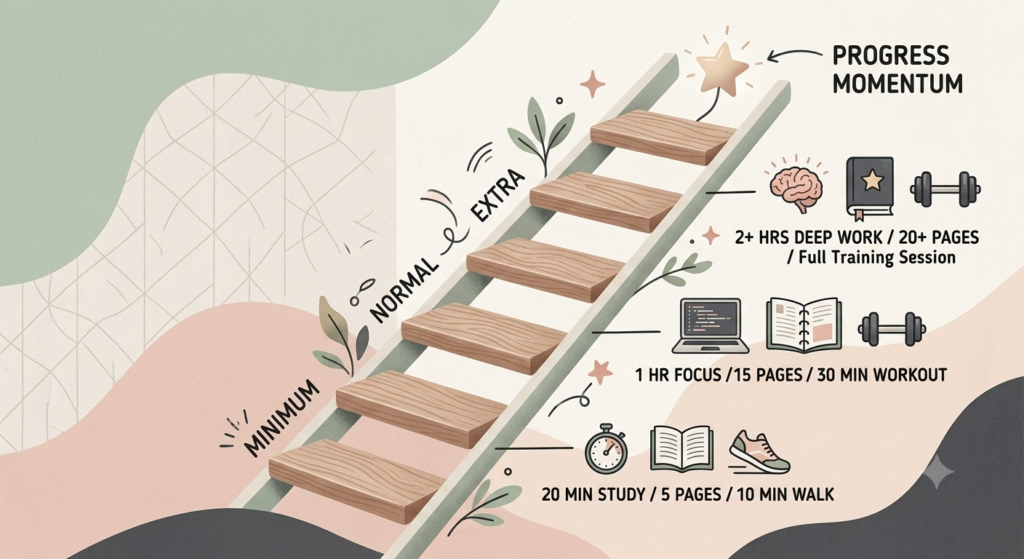
A Consistency Ladder replaces rigid demands with a flexible three-tier system:
Level 1: Minimum Tier
This is the absolute baseline version of your habit. It requires minimal time and energy (for example, 15 to 20 minutes of studying). You use Level 1 on busy days, exam weeks, or when feeling under the weather. Its sole purpose is to keep the chain unbroken.
Level 2: Normal Tier
This represents your standard daily routine when operations run smoothly (for example, 1 hour of focused effort). This is your primary target on typical weekdays.
Level 3: Extra Tier
This tier is reserved for high-energy days when you have extra time and focus (for example, 2 hours of deep work).
Your weekly execution might look like this: Level 3 on Monday, Level 2 on Tuesday, Level 1 on Wednesday, Level 3 on Thursday, and Level 2 on Friday. Because your system accounts for varying energy levels, you maintain forward momentum without suffering from burnout.
Master the 24-Hour Return Rule
Missing a day is an inevitable part of life. Unexpected obligations arise, illnesses occur, and schedule disruptions happen. Understanding how to be consistent means recognizing that missing one day is simply an isolated event.
The real danger lies in letting a single missed day snowball into five consecutive missed days, turning a temporary lapse into a long-term pattern.
Avoid the Compensation Trap
The 24-Hour Return Rule states that if you miss a scheduled habit today, your sole priority tomorrow is to return to the task. Crucially, your comeback should be intentionally easy.
Most people make the mistake of attempting to compensate for missed time. If they fail to study on Monday, they try to study double the duration on Tuesday. This approach turns restarting into a punishment and increases resistance.
You are trying to rebuild momentum, not repay a debt. If you missed your study session yesterday, do not attempt a four-hour marathon today. Simply complete your Level 1 minimum routine (15 to 20 minutes). Making the return easy removes anxiety and restores your habit loop smoothly.
Track Evidence, Not Streaks
Streak counters and habit-tracking apps can provide initial motivation, but they come with a hidden downside. When you build a 30-day streak and accidentally break it on day 31, resetting the counter to zero feels disheartening. It creates the illusion that thirty days of hard work vanished instantly.
Instead of relying solely on consecutive streaks, focus on collecting evidence of your progress. Shift your focus from ‘Did I perform this perfectly every single day?’ to evaluating your overall trend line.
Conduct a Weekly Systems Review
At the end of each week, analyze your performance by asking three straightforward questions:
1. Did I show up more times this week compared to last month?
2. What specific friction made starting difficult on off days?
3. What adjustments can I make to improve the workflow?
Consistency is an evolving process rather than a static rulebook. Improving your routines often requires refining the plan rather than forcing the same rigid schedule forever.
Summary: Framework for Long-Term Consistency
Here is a quick overview of the five core consistency rules and their practical execution strategies:
| Rule / Principle | Core Problem Solved | Actionable Step |
| 1. Default Version | Over-promising on low-energy days | Define the smallest baseline habit that still counts. |
| 2. Decide Beforehand | Decision fatigue and procrastination | Pre-select tasks and organize physical workspace early. |
| 3. Consistency Ladder | All-or-nothing binary thinking | Use a 3-tier routine (Minimum, Normal, Extra). |
| 4. 24-Hour Return Rule | Snowballing missed days into failure | Return the next day using an intentionally easy version. |
| 5. Track Evidence | Demoralization from broken streak counters | Review weekly progress trends and refine friction points. |
Recommended Resources & Further Reading
To further enhance your productivity and daily workflow, explore these guide links:
• External Resource: Deep dive into habit building and behavioral design on
👉 https://www.jamesclear.com/habits (James Clear Behavioral Psychology Guides)
• Internal Resource: Discover essential life skills for real-world growth:
👉 https://levikahdaila.com/16-skills-every-teenager-should-learn/
Frequently Asked Questions (FAQs)
Q1: What should I do if I keep missing days despite lowering my goals?
If you are still struggling to complete your baseline habit, your default version is likely still too large. Shrink the requirement further. Reduce a 20-minute session down to 5 minutes or even 2 minutes. The primary initial objective is establishing the habit loop; duration can be increased once consistency is stable.
Q2: Is it acceptable to modify my schedule when my routines feel repetitive?
Yes. Consistency does not mean keeping the exact same structure indefinitely. As your commitments, school schedules, or job demands shift, your productivity system should adapt accordingly. Updating your framework is a normal part of maintaining long-term performance.
Q3: How long does it take for a new routine to feel automatic?
Habit formation timelines vary depending on the complexity of the action and your environment. Rather than focusing on a fixed number of days, focus on total repetitions. The more times you execute your baseline version without friction, the faster the behavior becomes automatic.
Conclusion
Building consistency is not about achieving a flawless record or forcing perfection every single day. Real progress comes from understanding how to keep returning to your core habits when disruptions happen.
By lowering the bar on low-energy days, reducing decision fatigue, using flexible systems like the Consistency Ladder, and returning quickly without guilt, you build a sustainable routine. Pick one habit today, establish your baseline version, and focus on steady execution.