

Have you ever jumped into something with full gusto and gave up after a few days?
Perhaps you were all determined to study everyday, exercise on a regular basis, and do whatever you have been putting off for so long. At first, you felt enthusiastic and energized about it.
However, after a few days, the enthusiasm disappeared, and tiredness set in. Distractions became increasingly appealing, and doing your tasks on a daily basis seemed hard to accomplish. Finally, you told yourself that you will start from tomorrow.
And tomorrow turned out to be yet another tomorrow.Now, the point is not that you are being lazy or unmotivated. Rather, the issue lies in your dependency on motivation.
Table of Contents
- Motivation helps you start, but discipline helps you continue.
- 1. Stop Waiting for Motivation
- 2. Set Clear Goals and Make Them Small
- 3. Create an Environment That Supports Discipline
- 4. Focus on Consistency, Not Perfection
- 5. Learn to Work Through Discomfort
- 6. Track Your Progress and Remember Your Purpose
- Frequently Asked Questions (FAQs)
- Conclusion: Become Someone Who Follows Through
Motivation helps you start, but discipline helps you continue.
Developing self-discipline and being able to be consistent is not about making yourself work around the clock. It is all about having systems in place which help you progress, even when you lack motivation.
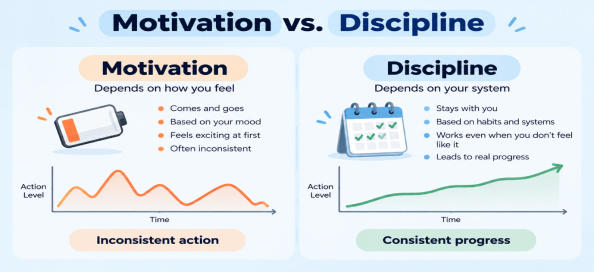
Below are six tips for developing self-discipline and consistency.
1. Stop Waiting for Motivation
One of the greatest blunders that people commit is waiting till they feel ready to start.
They may be telling themselves that they will read only when they feel focused, exercise only when they feel energetic, and work on some project only when inspiration hits them. But the reality is that their motivation will fluctuate daily.
If their actions are entirely dependent on how they feel, then their performance will surely vary.
The disciplined ones get bored and lazy as well; however, they understand that feelings cannot dictate everything.
Suppose you have planned to study for an hour, but when the time comes, you would love to watch movies. Rather than waiting for sudden motivation to come, you can simply open your book and start reading just for 5 minutes.
By doing so, you will not face much pressure in doing the whole thing at once. By starting with something, continuing becomes easier.
What to do: Whenever you find yourself delaying something, you should ask yourself, “What is the smallest thing I can do right now?”
You do not need to finish everything in one shot. Just start!
2. Set Clear Goals and Make Them Small
At other times, you postpone certain tasks due to the fact that the task appears to be too large and complex.
Compare the phrases, “I have to study chemistry” and “I will revise chemical bonding and do ten tasks.” The first goal is ambiguous. The second one is very clear.
If your goals are ambiguous, you need extra time to define how to get started on your goal. And this can make it easier for you to skip the task altogether.
If you divide large goals into small actions, you’ll be able to cope with them much better. Instead of scheduling yourself to read a whole book within a week, start with five pages per day. Rather than learning the new skill right away, practice its single aspect during fifteen minutes.
Performing small actions helps you create opportunities to act consistently without being overwhelmed by your goals.
It would be beneficial to schedule your actions too. You may want to read for fifteen minutes after breakfast or revise your notes at seven in the evening.
What to do: Transform your goals into actions and schedule your actions.Remember, the goal is not to create an impressive plan. It is to create a plan you can actually follow.
3. Create an Environment That Supports Discipline
The environment around you could be impacting your actions more than you know.
Imagine attempting to focus on your assignment with your phone by your side, getting distracted with notifications and having many entertainment websites open on your computer.
Each distraction is one more chance for you to get distracted. Even though you might tell yourself to focus, your environment prevents you from doing so.
It is easier to modify your surroundings rather than always relying on willpower alone.
If you want to study, put your phone away from your desk, block any unnecessary notifications. If you want to work out in the morning, have your clothes ready beforehand. If you want to read more, have a book within easy reach.
By making these small changes, you are making the process of starting much easier.
Repetition of the same routine in the same environment could assist in making the environment associated with the specific activity.
What to do: before starting an important task, take two minutes to prepare the environment for yourself – make sure you have everything close to you and eliminate the distractions that could disrupt you.
You do not have to become better at resisting every distraction. Sometimes, the simplest solution is to make the distraction less available.
4. Focus on Consistency, Not Perfection
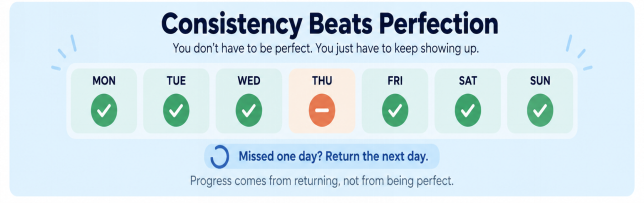
One missed day does not destroy a habit. The real problem begins when you use one missed day as a reason to stop completely.
For example, suppose you plan on exercising five days per week but skip Wednesday. Then you could become disappointed and opt for starting again on Monday.
Maybe you planned to study every evening, yet you used one of the evenings for watching TV. Instead of resuming your usual plan the next day, you assume that you have already failed.
This is the trap of perfection.
When you demand perfection from yourself, then one little mistake makes you want to give up.
The right way to do things is to realize that sometimes things do not work out as expected. You could have some other obligations, feel tired, or need extra rest. What really counts is what you do about it.
If you did not have a study session, then you start again the next day. If you cannot do your usual training, then you could do a lighter session instead.
The idea here is not to decrease your expectations permanently. The idea is to make your habits flexible enough to withstand reality.
What to do: When you fall out of your routine, avoid waiting for the perfect moment to restart. Identify your next opportunity and take one manageable step.
Discipline is not about never making mistakes. It is about learning how to return to the process.
5. Learn to Work Through Discomfort
Discipline does not imply that everything becomes enjoyable. On occasions, you have to do something significant despite being bored, tired, or frustrated.
A demanding academic pursuit may take more time than anticipated. Mastering an unfamiliar skill may be accompanied by errors. Pursuing a distant goal may include putting efforts without immediate effects.
At such times, it can be tempting to think that you are not progressing and/or that the task does not suit you.
Nevertheless, discomfort is not necessarily a sign of the need to stop. Quite often, it just means that you have to put some efforts into completing the task.
It does not mean, though, that you are supposed to neglect your fatigue and keep going despite it. On the contrary, sustainable discipline also means understanding that it is time for a break.
The crucial point is to stop treating any moment of resistance as an excuse to procrastinate.
What to do: When a task feels difficult to begin, commit to working on it for another five minutes. Focus on one small part rather than thinking about everything that remains.
You may not always feel like continuing afterward, and that is okay. The goal is to practice beginning even when the task does not feel appealing.
6. Track Your Progress and Remember Your Purpose
It is much easier to discipline yourself once you know why you do it and can observe your progress.
Ask yourself why you pursue the particular goal. It might be about building a career, gaining independence, becoming healthier or mastering a skill you are interested in.
Your motivation does not have to be anything impressive. It just needs to be important for you personally.
When it seems like you are moving slowly towards your goal, think about your motivation to connect again with what you are striving for.
In addition, the monitoring of your behavior will show you how strictly you are sticking to your plan. No special techniques are necessary here. Just a pen and paper, a calendar, or a checklist are enough.
For instance, if you wish to create a reading habit, put a checkmark every day you read a book. If you aim to study regularly, track the periods you spend on studying.
At the end of each week evaluate what works and what doesn’t work for you. Make changes in your habits according to your observations.
What to do: Choose one important goal, write down why it matters, and track your daily actions. Review your progress once a week and make one practical improvement.
Small steps may not produce immediate results, but tracking them helps you see the effort you are putting in and where you can improve.
Frequently Asked Questions (FAQs)
1. How long does it take to build self-discipline?
Self-discipline requires time and effort. Create small, easy-to-follow habits and make sure to stick with them consistently.
2. How can I stay disciplined when I have no motivation?
Set up a goal, get rid of distractions, and start with an action regardless of whether you feel like doing it or not. Even a small routine may help you stick to your plan even when the mood is different.
3. Why do I struggle to stay consistent with my habits?
You might be setting unattainable goals, overusing the power of motivation, or getting distracted all the time. Make your habits easier to keep up with, check how well you do that, and go back to your routine after missing a day.
Conclusion: Become Someone Who Follows Through
The process of becoming totally undisciplined doesn’t necessarily involve you completely altering your lifestyle all at once.
This process involves basic decision making: beginning a job that needs to be done when you are feeling lazy, putting away your phone because you need to pay attention, sticking to an achievable plan, and getting back to your normal routine after a tough day.
You are going to have days where you don’t feel like getting up. You are going to get distracted and have your doubts. Being disciplined doesn’t imply eliminating every challenge.
It is more about learning how to act without assuming every day will be perfect.
Your next move is to pick something that you’ve been putting off. Pick something specific, eliminate one distraction, and spend five minutes on it.
Don’t stress out about becoming disciplined today. Learn how to perform basic tasks that you can repeat.
You do not build discipline through one big decision. You build it every time you choose to follow through, one step at a time.