
Discipline is one of those words that sounds impressive until it asks you to do something inconvenient.
It sounds perfect while you are planning your day in the evening. You tell yourself that you will wake up early, exercise, study without using your mobile phone, eat properly, complete your tasks and turn yourself into a highly organized individual by the next morning.
But the next morning comes. The alarm clock goes off.
Suddenly, your bed seems to become the most comfortable place on Earth, you somehow manage to find your mobile phone and negotiate with the schedule you have made eight hours earlier.
This is when the discipline really starts.
Not when you are motivated. Not when everything is fine. Discipline starts in the situations when it requires a little bit more effort from you to do the right thing than just to follow the easier way.
And the best part of the story is that discipline is not something that you either have or you don’t.
Discipline can be developed.
Through punishment? Through difficult exercises? Definitely not by mimicking someone else’s early morning schedule?
Definitely not.
Only through a few basic principles but before that we should know why discipline matters more than motivation.
Why Discipline Matters More Than Motivation
Motivation is great. It makes you watch a productivity video late at night and all of a sudden, you realize that tomorrow you will wake up earlier, sort yourself out, tidy up your room, exercise, study, and transform your life in many ways before breakfast time.
The thing is that motivation is a temperamental state. Some days you are motivated in everything you do. Other days even finding your charger requires an effort. If your actions rely entirely on motivation, your success will be affected by the way you are feeling on a given day.
This is where discipline comes into play. Discipline gives structure to your actions regardless of your mood. It enables you to continue working on your goals despite the lack of motivation.
Take the example of brushing your teeth. Rarely anyone stands in front of the bathroom every night waiting for inspiration. This is something you do without thinking much about it because it has turned into your habit. No need to make any decisions, give yourself a motivational talk, or wait to feel excited.
This is the objective when it comes to self-discipline as well.
Ultimately, the most established habits become so automatic that they do not require continual motivation. There is no need to persuade yourself all the time. The habit is part of your lifestyle.
When learning about the concept of self-discipline, it is essential to consider the following mind shift:
“Do I feel like doing this?”
“Do I think that this is important?”
You should allow your mood to have its opinion, but it does not always have to control everything.
Discipline Is Already Everywhere in Nature
We often think of discipline as an artificial construct created by efficiency specialists, but just take a look at nature around us it works on rhythm, order, and repetition. The Sun does not just randomly choose to come up in the middle of lunch time because yesterday it was too tired. The Earth continues turning, the Moon revolves, seasons come regularly, tides go up and down, plants operate in biological rhythms, and birds migrate according to natural rhythms.
The same happens with our bodies. We sleep, our hormones act, we digest food, our temperature changes, and we become more or less alert at certain times. Nature is not “disciplined” in terms of human psychology, of course, because all of this happens due to physical and biological laws. However, there is something very important about that stable systems require patterns.
Think how life would be if the Earth started changing its speed of rotation from time to time depending on its feelings, or if the seasons came unpredictably. Life would become very complicated, to say the least. Universe operates thanks to so many processes being repetitive enough to establish order.Human life is not very different. Our routines become the small patterns around which everything else can organize itself. Sleeping at a reasonable time helps the next day feel easier. Preparing your things beforehand reduces morning chaos. Saving regularly
1. Begin with Clarity
The act of self-discipline is greatly simplified when there is clarity about what is required of us in order for us to become disciplined. Many individuals attempt to emulate others by adopting routines that seem highly disciplined without questioning whether these routines fit into the lives of said individuals. Waking up at 5 o’clock in the morning, reading fifty pages every single day, spending an hour in the gym, writing in a journal, meditating, and scheduling everything can make one extremely productive, yet if none of these leads anywhere, it quickly drains one.
Clarity is the key to self-discipline because it gives us motivation. One can desire to get up earlier in order to have a more peaceful morning. One may wish to study every day as to avoid the pressure of cramming information. One can wish to exercise as to gain more energy during the day. One can desire to cut down on the number of hours one spends on social media so as to create some mental space.
In all these instances the discipline is not a punishment anymore but rather protection.
A disciplined life does not begin with doing everything. It begins with deciding what is important enough to deserve your consistency.
2. Build Consistency Before Intensity
There is nothing faster to ruin a new habit than making it excessively hard right from the beginning.
Many people think that discipline should always involve drastic changes. People convince themselves that they will get up two hours earlier, exercise regularly, cut off all social networking sites, spend four hours studying and read one book per week.
Initially, it is fun.
After some time, however, the reality strikes.
True discipline does not shout. It means writing ten pages instead of reading an entire book in just one weekend. It implies half an hour of concentrated studying as opposed to studying six hours before taking an exam. True discipline also means doing something that you can repeat and not getting tired with just one exhausting training session.
At first, the point is not to impress yourself, but to show yourself that you can continue tomorrow.
Even minor steps gain power because of repetition.
When something becomes part of your normal routine, you no longer need to make a big decision every time. You just do it.
That is when discipline begins to feel less like effort and more like identity.
3. Design Your Environment
What sometimes appears as a lack of discipline is a poorly constructed environment.
Think of having your concentration disrupted by your phone being right next to you, having notifications pop up every few minutes, having your desk full of papers, and having five distracting tabs open. All of these things can be battled against through sheer force of willpower, but why make your job tougher than necessary?
The world around you impact you far more than you know.
If you wish to read more often, put your books in an easily noticeable spot. If you need to exercise in the morning, have your clothes ready the night before. If your phone keeps bothering you at work, keep it far enough away from you so you will have to stand up to get it.
The idea is simple: make good habits easy to start and bad habits slightly harder to reach.
Disciplined individuals do not have to be stronger than others. They just find themselves in fewer situations where they have to fight against themselves.
You do not get extra points for surrounding yourself with distractions and resisting them.
Sometimes the smartest form of discipline is removing the distraction in the first place.
4. Learn to Delay Immediate Comfort
And that’s where the discomfort arises in being disciplined.
There will always be times when the right decision is not the easiest.
Scanning through Facebook feels like the easiest option. Sleeping in feels like the easiest option. Avoiding the difficult discussion feels like the easiest option. Avoiding the task feels like the easiest option.
But here’s the thing easy options tend to come with their consequences sometime down the road.
Another hour on Facebook feels fine until you’re in a hurry trying to complete your tasks at midnight. Not sleeping today feels fine until you feel more exhausted in the morning. Evading something difficult feels good until the problem is even more daunting.
Discipline provides a gap between your action and feeling.
One good question would be:
“Will I still be glad about my choice tomorrow?”
But that does not necessarily imply that you should take enjoyment out of your life. Rest is important. Having fun is also important. Going out, seeing a movie, enjoying what you like eating, and not doing anything for a while are all healthy things to do.
The key point here is whether you choose the break or whether you escape into it.
This is not about denying yourself anything pleasurable. This is about ensuring that temporary pleasure does not always result in future stress.
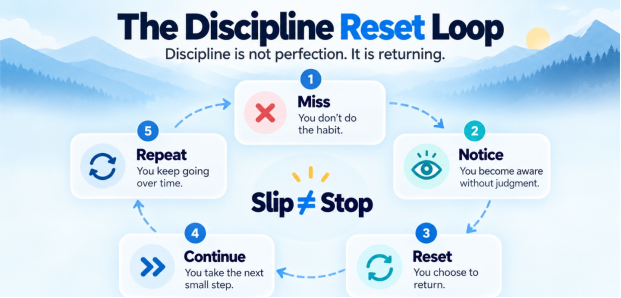
5. Become Good at Starting Again
This may be the most critical element of the whole system. You will disrupt your daily habits.
Eventually, you will oversleep. You will waste your time. You will miss your exercise. You will put things off. You will have days when almost nothing will go right.
That doesn’t necessarily mean that your self-control is lost.
The real problem arises when that one day turns into an excuse for another.
You miss your Monday and say, “I’m going to get started next week.” And the next week turns into the next month. It’s much more effective to set a much simpler rule for yourself.
Did you fail to follow your morning routine? Make the afternoon routine productive. Missed one session of studies? Return the next time. Stayed up late again? Go back to bed as usual the next night. Wasted a day? Don’t let it become a reason for another wasted day.
Self-control is not about being absolutely perfect. It’s about being really good at returning.
That ability makes your habits much stronger because your routine no longer depends on life being perfect.
And life is almost never perfect.
FAQs
1. Is discipline more important than motivation?
Motivation drives you to get started, but discipline drives you through the process. Motivation varies depending on your mood, energy, and circumstances, while discipline creates a framework that helps you go through even on those days when you are not motivated.
2. What should I do if I keep breaking my routine?
Do not attempt to make all the changes right away. Simplify the routine and make it easy to perform. If you skip a day, go back to it as soon as possible rather than waiting until Monday, next month, or the perfect opportunity to resume.
3. Can discipline make you happier?
Yes, because discipline can help decrease unnecessary stress and organize your life better. When necessary, things are taken care of in time, you have more opportunities to relax, enjoy your life, and be calm rather than preoccupied with undone tasks.
Conclusion
Discipline is not about being harder on yourself, busier, or more perfect. It is about being someone who can count on themselves. Being someone who does the things that matter regardless of the lack of motivation, who gets up from their failures, and who continues regardless of whether they have all the conditions right first.
Eventually, these small decisions start making your day, and your days start forming your life. You feel calmer since there is less uncertainty in your life, more confident since you make good on your self-promises, and more liberated since there is no need for last minute panic or mood swings in your life. Ultimately, discipline is not about controlling your life. It is about bringing enough order into your life so that you can enjoy it.