
Even if you are a beginner
“Pata hai aaj kya hua?” Just that one line, and the other person wants to know the rest. Nothing dramatic has happened yet. You have simply opened a small question in their mind.
Learning how to become a great storyteller starts there: noticing what makes someone want to hear your next sentence. It could be curiosity, a familiar feeling, or the suspicion that something did not go according to plan.
Hi, I’m Levikah. I make videos, and one of my simplest shooting mistakes is also a useful storytelling example. It has a camera, a very confident first take, and one rather important button.
Table of Contents
- The take that never happened
- Stop trying to tell it perfectly
- You have been learning this since childhood
- Build your story with STORY
- Collect moments before you collect scripts
- Follow the change
- Cut the detail that sends us elsewhere
- Study storytellers without copying their voice
- A brand example you may remember
- Where storytelling becomes useful
- Turn one small incident into a story
- Make a five-minute first draft
- Your mini story planner
- Start where you are
- How can I become a great storyteller as a beginner?
- What are the five elements of the STORY framework?
- Do I need exciting experiences to tell good stories?
- How do I create suspense without being dramatic?
- Should I memorise every word of my story?
- Can introverts become good storytellers?
- How long should a personal story be?
- Do I need a degree to tell stories?
- Give someone a reason to keep listening
- Watch the companion video
- Keep exploring
- A useful storytelling resource
01 / YOU ALREADY HAVE A STORY
The take that never happened
I was properly ready for a shoot. The lighting was set, the camera was on, and everything looked right. Then I delivered what felt like my best take. Smooth delivery. No mistakes. Finally, a recording I would not need to redo.
I went to check it. And that was when I realised I had not pressed record.
So, apparently, I had been performing for the camera for free. All that confidence, and not a second of footage. The take I eventually used was the next one. Unfortunately, this was not even the first time I had done it.
It is a small incident. But you can follow what I expected, the moment things changed, and how I felt about it. That gives the incident a shape. You are not hearing a full report about the shoot; you are following one experience.
NOTICE THE CHANGE | The camera story moves from “I finally got it right” to “none of it was recorded”. That contrast gives the story somewhere to go.
Stop trying to tell it perfectly
If I included the exact time, every camera setting, and everything I did before sitting down, the important moment would take much longer to arrive. The details might all be true, but they would not all help you follow this particular story.
Preparation helps. Memorising every sentence can become a problem when you are more focused on getting the wording right than on communicating the moment. Know the main beats, then leave room for your normal voice.
A natural pause, a small expression, or a line you would actually say to a friend can carry more feeling than an elaborate description. Keep the details that help us picture the scene or understand why it mattered.
You have been learning this since childhood
Many of us first met stories through a dadi, nani, parent, or another person who made a whole scene appear in our minds. Later came Panchatantra, the Ramayana, fairy tales, or Harry Potter. We were following characters and wondering what happened next before we knew the names of storytelling techniques.
That familiarity is a useful starting point. You do not need to become a different personality. Begin with the way you already tell a friend about something funny, awkward, or unexpected.
02 / A CHECKLIST YOU CAN REMEMBER
Build your story with STORY
The five elements in my video spell STORY: Suspense, Truth, Originality, Relatability, and Your Voice. Use them to review a story you want to tell. They are a practical checklist, not a formula that every story must follow in the same way.
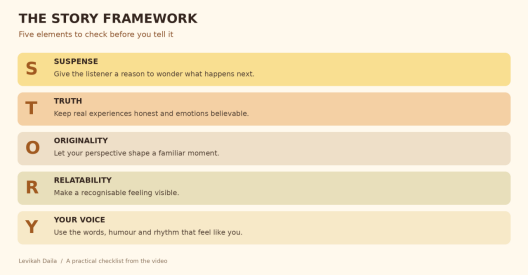
A quick visual checklist for the story you already have.
S is for Suspense
Give the listener a reason to wonder. In the camera story, feeling certain that the take was perfect sets up a question: what could possibly have gone wrong? You do not need to hide the answer for ages. Let curiosity lead somewhere.
T is for Truth
When you tell a real experience, keep the events honest. You can choose which details to include without making up a bigger disaster. Fiction can be invented, but it should not be presented as something that really happened to you.
O is for Originality
Forgetting to record is not a completely new experience. My reaction and the way I describe it make it mine. A familiar event can still feel fresh when you tell it from your own point of view.
R is for Relatability
Someone who has never filmed a video may still recognise that feeling: you think you have finished something, then discover you have to start again. Shared feelings can connect people across different experiences.
Y is for Your Voice
Your humour, vocabulary, expressions, and rhythm belong in the story. Use words you would actually say. You can learn from another storyteller without borrowing their whole personality.
03 / FIND IT IN AN ORDINARY DAY
Collect moments before you collect scripts
Interesting stories often begin with noticing. A friend changes their expression when a name comes up. Someone pretends they are not nervous before a presentation. A simple plan goes wrong in a way nobody expected. Those moments contain something worth exploring.
At the end of the day, ask: “What did I notice?” Keep a short note about one moment, what you expected, what changed, and how you reacted. You are making a small collection of things you may want to tell later, not turning every experience into content.
If a moment belongs to someone else, consider their privacy. You can leave out identifying details or ask before sharing. Being observant does not mean every conversation is yours to publish.
Follow the change
For a short personal story, try this simple order: setup, expectation, turn, reaction. It helps you find the part people are actually waiting for. It is one useful editing scaffold, not a rule for every kind of story.
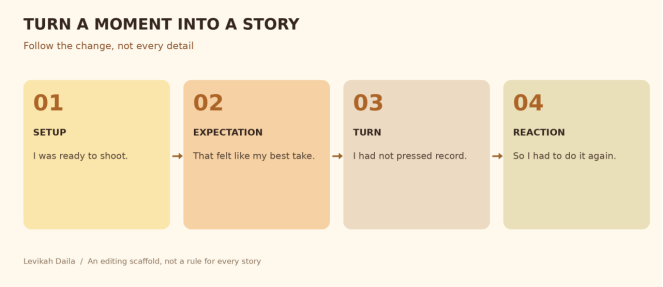
The same camera incident becomes easier to follow when the change is clear.
Cut the detail that sends us elsewhere
Ask what a detail is doing. Does it help us see the scene? Does it explain the change? Does it show the feeling? If it does none of those things, try telling the story without it.
The camera’s recording setting matters to a technical tutorial. For this story, the important detail is simply that recording had not started. The purpose of your story helps you decide what deserves space.
TRY THIS | Tell the same incident in 60 seconds, then in 30. Notice which details you keep both times.
04 / LEARN THE CHOICE BEHIND THE STORY
Study storytellers without copying their voice
When you enjoy a story, look at the choices behind it. Where did the speaker begin? Which detail made you picture the moment? When did they stop explaining and let a reaction speak for itself? You can study those decisions and test them in your own work.
In my video, I mention Raj Shamani, Prajakta Koli, Zakir Khan, and Oprah Winfrey as people to observe. They are different kinds of communicators. The useful exercise is to choose one conversation or performance and notice how the story is being told, rather than treat them as one style to imitate.
| What to observe | What to look for |
| A podcast conversation | Which follow-up question moves beyond a general answer into a specific experience? |
| An everyday comedy scene | Which familiar behaviour makes the scene recognisable? |
| A humorous personal story | How does the speaker pace the setup and the reveal? |
| An interview | Where does the speaker give someone space to describe what the experience meant? |
A brand example you may remember
Asian Paints’ “Har Ghar Kuch Kehta Hai” connects a home with the lives and memories inside it. The company describes the campaign in its own reporting as celebrating the emotional meaning of Indian homes. That gives us a useful example to examine: the product sits inside a human story.
A home can be described through wall colours and materials. It can also be described through someone moving in, growing up, or returning after a long time away. The second approach gives an audience a person or feeling to follow.
Source: Asian Paints campaign description in its 2024–25 reporting
Where storytelling becomes useful
A student can use a short incident to make a presentation easier to relate to. A creator can open a video with a moment that leads into the topic. A business can explain the problem behind a product. An interview can become more specific when someone describes what happened rather than only naming a quality.
That is why storytelling is worth practising. It supports communication across different settings. It does not guarantee a career or make every message better by default. The story still needs to serve what you are trying to say.
Related: Effective Communication Skills
05 / YOUR STORY LAB
Turn one small incident into a story
A REPORT
“I recorded a video, but I forgot to press record, so I did it again.”
A VERSION WITH A MOMENT TO FOLLOW
“I finished the take and thought, finally, that was the one. No mistakes. Smooth delivery. Then I checked the camera. I had not pressed record.”
The second version lets us share the expectation before we discover the problem. It does not require a bigger event. It simply chooses an order that makes the change noticeable.
Make a five-minute first draft
| Minute | What to do |
| 1 | Pick one real moment from your day. |
| 2 | Name what you expected and what actually happened. |
| 3 | Choose one detail that helps us picture it. |
| 4 | Write a short version in words you would normally use. |
| 5 | Say it aloud, remove one detour, and check whether the ending lands. |
Your mini story planner
The moment I want to tell: ____________________________________
What I expected: ___________________________________________
What changed: _____________________________________________
One detail worth keeping: ___________________________________
What I felt or thought: ______________________________________
The line I want to finish on: __________________________________
Try your version with someone you trust. Ask which part they pictured most clearly and where their attention drifted. You do not need a dramatic voice or a perfect first attempt. You need something specific enough to work on.
KEEP IT YOURS | Use feedback to make the story clearer. Keep the expressions that sound like you.
06 / FREQUENTLY ASKED QUESTIONS
Start where you are
How can I become a great storyteller as a beginner?
Start with a small experience you remember clearly. Explain what you expected, what changed, and how you reacted. Tell it aloud, remove distracting details, and notice what your listener responds to.
What are the five elements of the STORY framework?
In this guide, STORY stands for Suspense, Truth, Originality, Relatability, and Your Voice. It is the practical checklist from Levikah’s video, not a universal definition of every storytelling method.
Do I need exciting experiences to tell good stories?
No. A small misunderstanding, an awkward moment, or a plan that changes can give you something to tell. Look for a specific detail and a feeling that another person can recognise.
How do I create suspense without being dramatic?
Let the listener understand an expectation before revealing what changed. Keep the question connected to a real payoff. Avoid exaggerating events or delaying the answer so long that the story becomes frustrating.
Should I memorise every word of my story?
Usually, knowing the main beats is a useful place to start. Some performances need precise wording, but an everyday story can sound more comfortable when you leave room for your natural phrasing.
Can introverts become good storytellers?
Yes. Storytelling does not require being the loudest person in the room. Observation, clear details, and thoughtful pacing can work in a quiet conversation as well as on a stage.
How long should a personal story be?
Long enough for the listener to follow the moment and understand why it matters. The setting decides what fits. A short conversation, a presentation, and a long video may need very different lengths.
Do I need a degree to tell stories?
There is no degree requirement for telling an engaging personal story. Practice, listening, observation, and feedback can help you improve. Professional work may also require subject knowledge, research, or other skills depending on the role.
TAKE IT INTO YOUR NEXT CONVERSATION
Give someone a reason to keep listening
The next time something funny, frustrating, or unexpected happens, notice the moment before you decide there is nothing to say. What were you expecting? What changed? What detail would help someone else picture it?
That is enough for a place to begin. You can shape the story as you practise. Keep the feeling honest, give the listener a scene to follow, and let your own voice stay in it.
YOUR NEXT STORY | Choose one ordinary moment today. Tell it so someone else can imagine being there.
If you try the planner, share the moment you chose in the comments. Send this guide to a friend who wants to tell stories with more confidence, and explore the video on the Levikah Daila YouTube channel.
Watch the companion video
How to Become a Great Storyteller (Even If You’re a Beginner) | Levikah Daila
FIND THE VIDEO > Levikah Daila’s channel
This opens a channel search for the video, not a direct watch URL.
Keep exploring
Effective Communication Skills: 7 Powerful Ways to Improve
More articles by Levikah Daila
A useful storytelling resource
The National Storytelling Network describes oral storytelling as an interaction that invites the listener to imagine the story. Its explanation is useful if you want to explore why gestures, voice, and the listener’s response matter alongside the words.