
Sometimes the problem is not that an idea is too complicated. The real issue is that the explanation makes the idea feel complicated.
You may understand something perfectly in your head but when you try to explain the idea the other person looks confused loses interest or misses the point completely. That is where clear communication really matters. A good explanation does not try to show how much you know. It helps the other person understand what matters in the order without feeling overwhelmed.
The goal is simple: make the path, to understanding easier.
You Know Too Much
Sometimes the reason people do not understand your explanation is not because the idea is too difficult. It is because you already know it well.
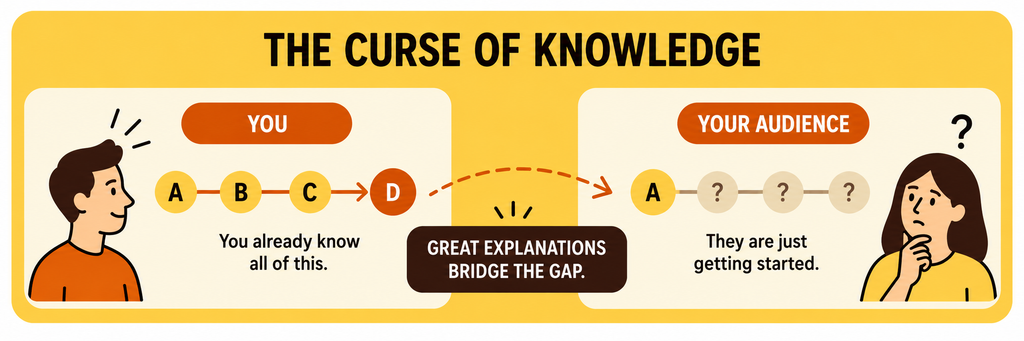
When you have spent a lot of time learning something the basics start feeling obvious. You forget which words once confused your which steps took time to understand and which connections were not clear at first. So, while you are already, at point D the person listening may still be trying to understand point A.
This is known as the Curse of Knowledge. The more familiar you become with an idea, the harder it can be to remember what it feels like to hear it for the time. How to explain ideas in…
That is why explaining well starts with a small shift: stop speaking only from what you know and start thinking about what they need to know first. You do not have to show everything in your head once. You just have to give people a place to begin.
Because the best explanation is not the one that sounds the smartest. It is the one that makes someone think, “Oh now that makes sense.”
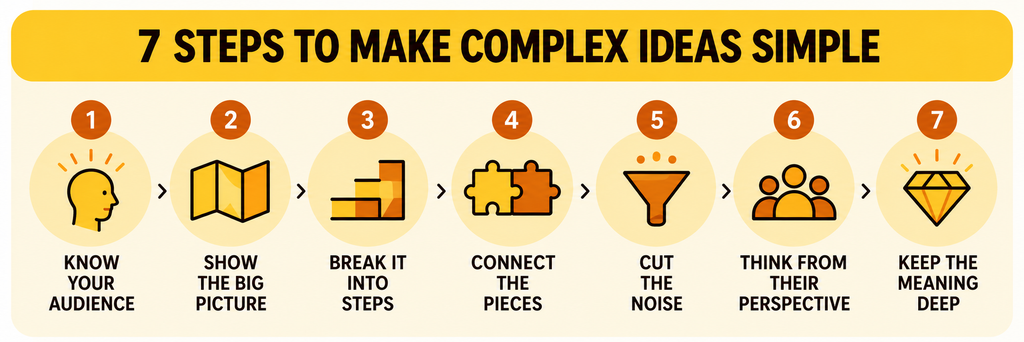
Zoom Out Before You Zoom In
When an idea is difficult I feel that hopping into the details can make people feel lost before they even understand what the topic really means.
A better approach is to start with the picture first. Give people a view of what is happening why it matters and how the idea works overall.
Once they have that picture the smaller details become much easier to fit.
Think about explaining how a camera takes a photo. If you start with sensors, pixels, lenses and image processing it can sound technical quickly. If you first say, “A camera captures light and turns it into the image you see ” the rest suddenly has somewhere to fit.
That is the power of zooming out first.
People understand details better when they already know what those details belong to. So, before you explain the pieces give them the map.
First show the picture. Then explain the pixels.
- Turn One Big Idea into Small Steps
A complicated idea often seems hard because there is much information being shared all at once.
Of sharing everything all at the same time divide the idea into smaller pieces and explain each part in a simple and clear order. This allows people time to learn one thing before going on to the next.
Every part should feel like a next step, after the previous one. When people can move through the idea slowly the complete picture becomes much easier to grasp.
A large idea is simpler to understand when people can learn it one part at a time.
- Make the Pieces Connect
Breaking an idea into parts is helpful but that alone is not enough.
People also need to understand how those parts connect.
An explanation can still feel confusing if every point makes sense individually but the audience cannot see how one point leads to the next.
Good communication creates a path, between ideas.
That connection is what turns pieces of information into one complete picture.
Do not just give people the pieces. Show them how the pieces fit together.

Cut the Noise, Keep the Meaning
Knowing more does not mean you have to say more.
One of the mistakes people make when explaining something is trying to include every detail they know. The audience usually does not need everything at once. They need the information that helps them understand what matters now.
Good simplification is not about removing information. It is about removing what is unnecessary, distracting or too early.
The clearer the message, the easier it is for people to stay focused and remember the main idea.
Keep the meaning. Remove the noise, around it.
Switch Seats with Your Audience
It is simple to explain something from your point of view.
You already know the topic, the background and where the explanation is going. Your audience might not.
That is why good communication starts with thinking from their side. Of only asking, “What do I want to say?” ask, “What does this person need to understand first?”
This small change makes a difference, in the explanation. It helps you choose words, better order and the right amount of detail.
Good communication starts when you stop thinking like the speaker and start thinking like the listener.
Make It Simple, Not Shallow
There is a difference between making an idea simple and making it incomplete.
A simple explanation still keeps the meaning. It just presents that meaning in a way that feels easier to follow.
The goal is not to reduce the intelligence of the idea. The goal is to remove the confusion, around it.
When you explain something clearly people can understand the core first. Go deeper when they are ready.
Simple does not mean basic. It means clear enough to understand and strong enough to remember.
FAQs
What is the Curse of Knowledge in communication?
I have seen the Curse of Knowledge when someone knows a topic well that they forget what may still feel new or confusing to another. Good communication starts by explaining from the audience’s level of understanding.
How do you simplify an idea without dumbing it down?
Keep the meaning and cut out unnecessary confusion. Simplifying is not about making an idea intelligent; it is about making the path, to understanding clearer.
Why is audience perspective important when explaining ideas?
Because the audience may not have the knowledge or background thinking from their perspective helps choose the right starting point the right words and the right amount of detail.
How can I make my explanations easier to understand?
Start with the picture explain one idea at a time link each point naturally and avoid adding information that is not useful yet. Clear structure makes difficult topics feel easier to understand.
CONCLUSION
Explaining an idea well does not mean making the complex idea sound smaller. The goal of explaining an idea is to make the complex idea easier to follow.
The best communicators know when to step remove the noise break a complex idea into clear parts and guide people through those parts in the right order. They do not speak from what they know. They think about what the other person needs to understand.
That is the real difference between a confusing explanation of a complex idea and a powerful explanation of a complex idea.
You are not removing the depth of an idea. You are removing the distance, between an idea and the person trying to understand a complex idea. When that happens even something complicated can start to feel clear, connected and surprisingly simple.
[…] How to Explain Complex Ideas […]