

Your intention was to study. You have your books and notes in front of you and have decided that this time you will concentrate. Then you get a notification on your phone. You respond to the notification. Responding to a single notification turns into browsing and then suddenly you realize twenty minutes have gone.
Do not think that if you find yourself in such situations you are lazy and lack willpower. Today’s world is an environment in which almost everything demands our attention. Notifications, social media sites, and even short films and streams of information are intended to grab our attention.
For this reason, we need more than just willpower to be able to focus.
Table of Contents
- Focus Is a Skill, Not a Personality Trait
- 2. Build an Environment That Protects Your Attention
- 3. Work in Structured Cognitive Blocks
- 4. Reframe Distractions as Attention Workouts
- 5. Take Care of the Brain You Expect to Perform
- 6. Give Your Effort Meaning & Find Support
- Frequently Asked Questions (FAQs)
- Conclusion
Focus Is a Skill, Not a Personality Trait
Deeper focus is not about spending five hours at your desk. It is about dedicating all your time and energy to complete one assignment until you gain sufficient knowledge about it and have achieved something productive. You could spend three hours on your studies, but still keep switching between your phone, notes, and everything else around you.
Or you could spend half an hour and learn properly.
1. Start With Clarity
Perhaps one of the easiest ways to lose concentration is to start a task without being clear about what exactly you need to achieve.
• Not specific: “Study Chemistry”
• Specific: “Go through chemical bonding and answer 10 questions”
Since you know what needs to be done, there is no need for your mind to expend energy figuring out your next step. Before you begin, select one specific thing that you want to achieve. It can be answering some questions, going through one topic, or writing a brief summary.
Golden Rule: Don’t set the time to study. Set what you want to finish.
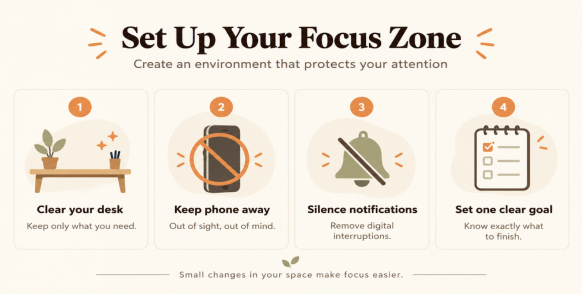
2. Build an Environment That Protects Your Attention
Your surroundings work silently on your behavior. Having a phone next to your laptop, opening unnecessary tabs, receiving notifications, and an unorganized desk all give chances for you to get distracted. Rather than resisting these distractions constantly, just eliminate them.
• Maintain a clean study place.
• Prepare what you will be needing only.
• Silence all unnecessary notifications.
• Do not have your phone nearby.
As time passes, the repetition of doing certain things in the same environment creates a very strong stimulus for you that “this is the place where I concentrate.” You do not build strength by constantly resisting distractions; you just limit their availability.
3. Work in Structured Cognitive Blocks
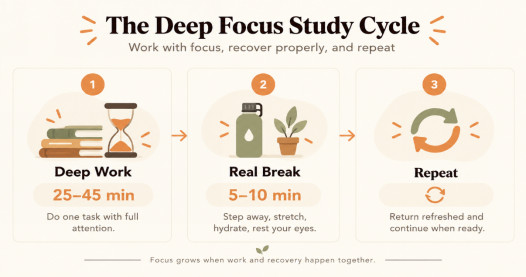
Of course, maintaining concentration becomes increasingly difficult the more you work nonstop. Rather than tracking your efficiency based on the number of hours you spend behind your desk, work in dedicated chunks.
• Work Focus Block (25-45 minutes): Do one thing without any distractions.
• Recovery Block (5-10 minutes): Move away from all screens. Stretch, hydrate, walk or just rest your eyes.
Recovery time shouldn’t immediately flood your brain with another piece of content. Both recovery and work are essential for deep work.
4. Reframe Distractions as Attention Workouts
No matter how perfect your technique is, your mind is going to drift. This is not about getting rid of distractions; it’s about recognizing that it’s happening and coming back from them more quickly.
If you find that you have gotten distracted, do not spend any time berating yourself for it. Just come back to whatever it is you’re supposed to be paying attention to.
Focus is not an absence of distraction. Focus is the ability to come back. The more often you do it, the better at it you get.
5. Take Care of the Brain You Expect to Perform
Concentration is not just about being productive, it is also based on your physical health.
• Sleep: Get good sleep to help with your memory and eliminate exhaustion.
• Constant Energy: Drink enough water and eat healthy food to prevent your energy from failing.
• Breaks: Let your brain take real breaks so that it can work efficiently.
You don’t have to follow the ideal plan all the time, but you cannot wear out your brain and then ask it to work at the highest level possible. Your quality of thinking depends on how you look after yourself.
6. Give Your Effort Meaning & Find Support
When you find yourself struggling with studies, even motivation might prove to be insufficient on some occasions. It is because having a purpose behind your efforts makes your work more valuable. Your purpose can be either an upcoming career, college education, independence, confidence, or simply improving oneself.
At the same time, you do not necessarily have to make this journey by yourself. It can be a friend, mentor, parent, or anyone who will believe in you and give you motivation to keep going.
Frequently Asked Questions (FAQs)
1. How long should a single study focus block last?
Try to work 25 to 45 minutes continuously, then take a 5 to 10-minute break. Beginning with smaller chunks will gradually help you develop mental stamina.
2. Why do I keep getting distracted even when I want to study?
Distractions usually stem from ambiguity or having digital distractions right at your fingertips, such as your mobile phone. Getting rid of ambiguity and your mobile phone will make it much easier for you to focus.
3. Is focus something you are born with or can anyone learn it?
Focus is something that can be learned through practice, not an inherent personality trait. It is built over time through small, repeated choices like removing distractions and defining clear targets.
Conclusion
People usually believe that focused individuals are naturally so, but it is not true. The ability of being focused develops in small decisions made on an ongoing basis. Whenever you put down your phone, formulate a target, persist in dealing with the problem, or refocus after your mind went astray, you train yourself to focus.
This may seem to be a minor change right now, yet with time these minor changes accumulate into a great capacity of concentrating, learning, and acting with intentionality.
Action Steps: For your next study session, start from the smaller. Pick up one specific thing to do, eliminate your major source of distraction, focus on it for 25-30 minutes, and come back after a real break.